

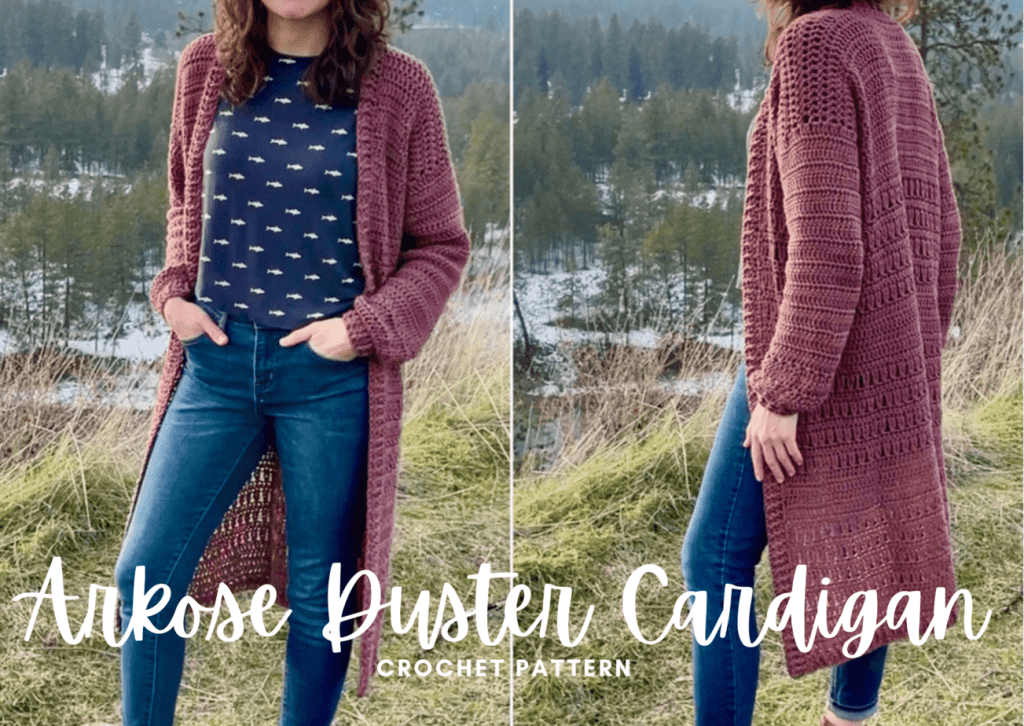
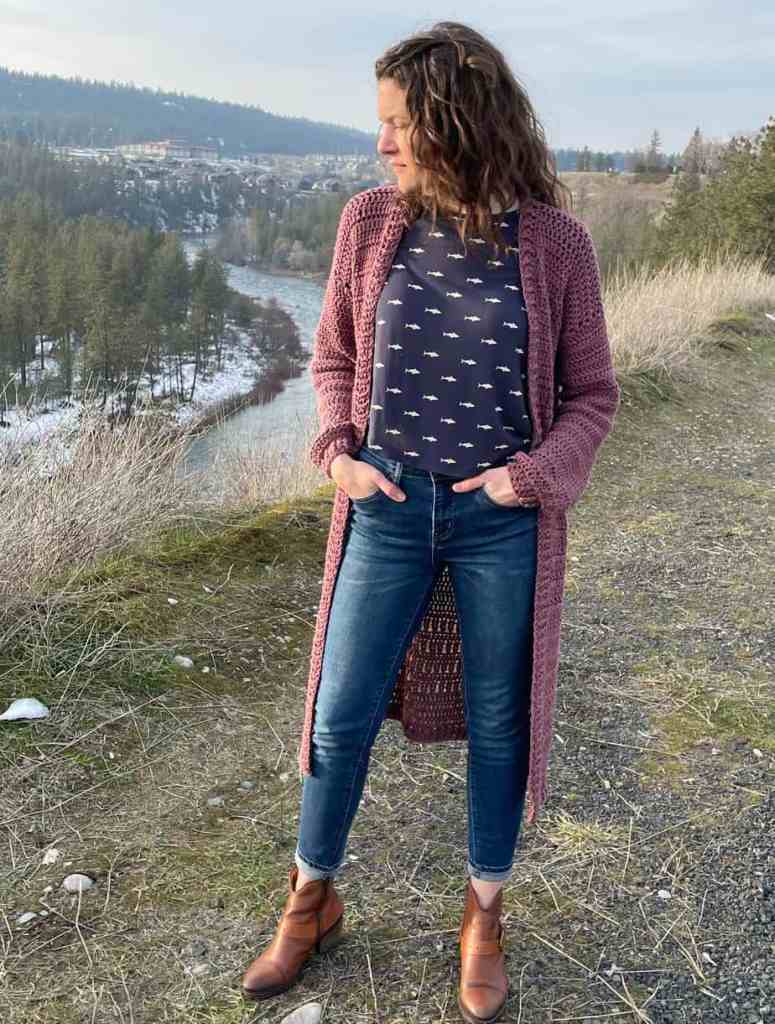
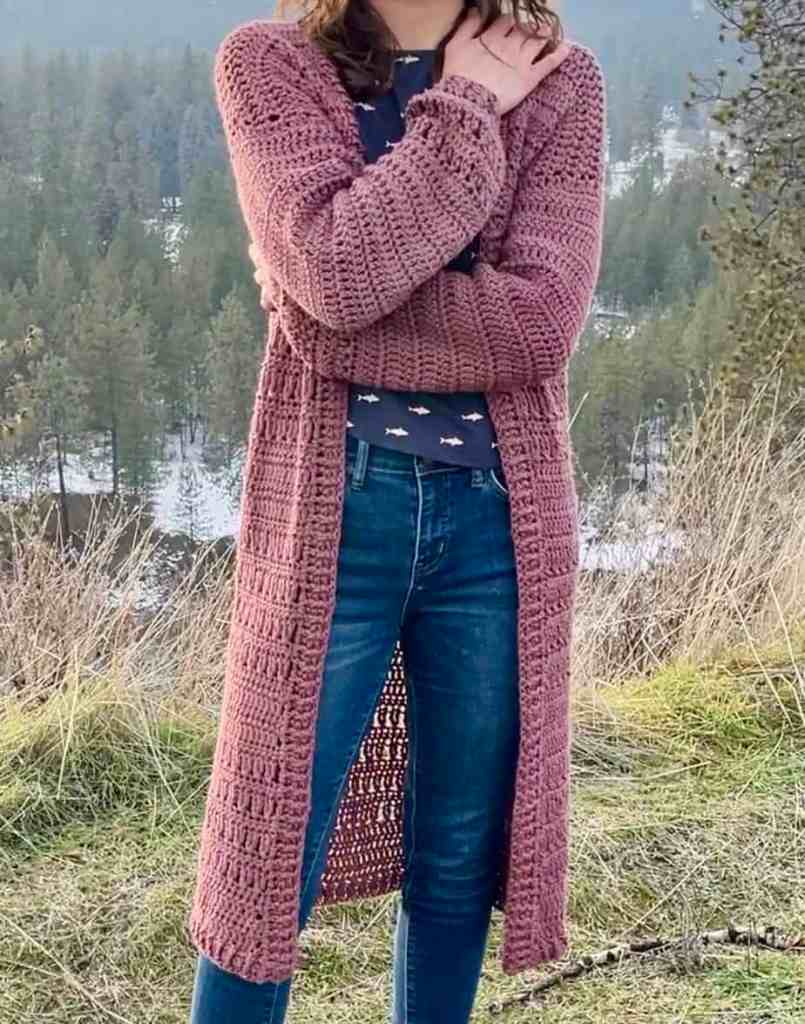
The Arkose Crochet Duster Cardigan pattern is the layer you reach for when you want the drama of a long cardigan without the weight of a jacket. It has a relaxed, open-front fit, tapered sleeves, and just enough texture to keep the fabric interesting while still letting that beautiful drape do most of the talking.
Although this duster cardigan crochet pattern uses worsted weight yarn, the larger hook and tall stitch pattern create a fabric that feels light, soft, and wonderfully fluid. I made mine in 100% cotton, so it is breathable enough for transitional weather but still cozy when the temperature starts making questionable decisions.
The pattern is written in nine sizes from XS through 5XL, and the length, sleeves, and body width can all be adjusted for the fit you want. Wear it over jeans and a tank, leggings and boots, or a dress when you want to look pulled together with suspiciously little effort.
The cardigan is named Arkose after a sandstone with coloring similar to the rose-taupe yarn I used. You can stay in that warm, earthy world or choose a color that feels completely your own.
Jump into the crochet duster cardigan pattern now, or pin it for later here!
LOVE COLLECTING Patterns?
If you love collecting crochet patterns, you might enjoy my Fiber Love Club — it gives you lifetime access to every pattern I’ve ever designed (plus all future releases).
Instead of buying patterns one by one, unlock the full pattern vault forever in one simple payment.
Why You’ll Love This Crochet Duster Cardigan
- The long, open-front shape instantly makes a simple outfit feel intentional.
- A larger hook gives worsted weight yarn a lighter, more fluid drape.
- The crossed treble crochet sections add texture without making the entire project complicated.
- Tapered sleeves keep the oversized silhouette from feeling bulky.
- The pattern includes nine sizes from XS through 5XL.
- You can adjust the body length, sleeve length, and width to suit your proportions and preferred fit.
- The new video tutorial lets you see the construction and trickier stitch sections in action.
How the Arkose Duster Cardigan Is Constructed
The cardigan begins as one large piece worked in turning rows from the lower back upward. After the lower body reaches the required length, the work is divided into three sections: one back panel and two front panels. The panels are continued separately and then seamed across the shoulders to create the arm openings and open front.
Next, a ribbed border is worked along one front edge, around the back of the neck, and down the opposite front edge. The sleeves are crocheted directly onto the arm openings in turning rounds, gradually tapered, and finished with ribbed cuffs.
In other words: no collection of mysterious garment pieces waiting around for you to remember how they fit together. The main body stays connected, and the finishing steps give it its final cardigan shape.
Printable PDF Crochet Pattern
This crochet pattern is reader supported by ads on my blog. If you’d rather print the pattern for some cozy couch crocheting, you can find the ad-free, printable PDF in my shop here or on Ravelry here.

🌿 Eco-Friendly Crafting
What makes this crochet pattern eco-friendly and sustainable?
THE YARN: I use only sustainable and eco-friendly yarn that has been ethically grown/raised and processed, putting the people and the planet first. This is why I chose 100% natural yarn for this pattern.
HANDMADE FOR LONGEVITY: Creating your own sustainable apparel promotes mindful consumption. This durable, handmade crochet duster reduces the need for mass-produced alternatives.
THE SLOW YARN MOVEMENT: I’m participating in the Slow Yarn Movement. There’s far too much to talk about here, but please take a few minutes to learn about what this means by reading the article I wrote about the Slow Yarn Movement as part of my 6-part Sustainable Crochet Series.
If you’re interested in learning more about sustainable crochet you can read all about it in the 6-part series I wrote covering everything about Sustainable Crochet and how to implement it into your own crafting starting today!
Materials You Will Need For This Crochet Duster Cardigan Pattern
Choosing Yarn for the Best Drape
I used 100% Pima cotton in a worsted weight for the original cardigan. Cotton gives the finished fabric softness, breathability, and enough weight to help the long silhouette hang beautifully.
You may substitute another worsted weight yarn, but make a gauge swatch before committing to cardigan quantities. Fiber content matters here: a springy wool or acrylic can create a warmer, loftier cardigan, while cotton, bamboo, or a soft plant-fiber blend will generally give you more fluid drape.
The goal is not simply to find another yarn with a number 4 on the label. You want a yarn that meets gauge and creates a fabric you would actually enjoy wearing. Swatching is not the most thrilling part of a cardigan, but neither is discovering at the shoulder seam that you have crocheted a tasteful area rug.
Yarn
- Lion Brand Yarns Pima Cotton | 100% Cotton | Weight 4 / Worsted
- ROSE TAUPE – x7(8, 8, 9 ,9)(10, 10, 11, 11)
Crochet Hooks Needed
Additional Supplies Needed
- Tapestry Needle (bent tips make all the difference!)
- Stitch Markers
- Scissors
- Measuring Tape
Abbreviations Used in the Crochet Duster Cardigan Pattern
This pattern is written in English, using US terms. If needed, you can find a handy term conversion chart right here in my Resource Library.
ch – chain
st – stitch
hk – hook
sk – skip
sl st – slip stitch
sc – single crochet
hdc – half double crochet
dc – double crochet
tr – treble crochet
fdc – foundation double crochet
fpdc – front post double crochet
bpdc – back post double crochet
dc2tog – double crochet 2 together
hdc2tog – half double crochet 2 together
ws – wrong side
rs – right side
inc – increase
dec – decrease
PH – photo reference number
(…) x – repeat x times
[…] – stitches in row/round
Skill Level
Intermediate
Best suited for crocheters comfortable with reading patterns and using a variety of techniques. This pattern may include more detailed construction, stitch patterns, shaping, color changes, or sewing.
Crochet Duster Cardigan Video Tutorial:
FAQ & Terms
Affiliate Links & Ad Support
This post may contain affiliate links. At no extra cost to you, purchases made through these links may earn Off the Beaten Hook a small commission which in no way affects the cost to you. The content on this site is supported by advertisements. By using this site, you agree not to circumvent, block, or tamper with these ads.
Copyright & Intellectual Property
All content on this blog, including free crochet patterns, instructions, charts, photos, videos, and written materials, are the property of Off the Beaten Hook and are protected under copyright and other intellectual property laws. Screenshots or any other method of copying the pattern for offline use or redistribution is prohibited. Sharing patterns in forums, social media groups, or private messages without permission is also prohibited.
Personal Viewing & Use Only
Free patterns published on this site are provided for viewing only on this blog. You may not copy, download, print, take screenshots, or redistribute the pattern in any form (digital or physical) outside this blog. You may not post the pattern or instructions elsewhere online or share it publicly without written consent.
Questions & Permissions
For questions about these permissions or to use or share patterns outside of these rules, please contact Off the Beaten Hook in writing.
Absolutely! You may sell finished items made from Off the Beaten Hook’s patterns, but please credit:
“Pattern by Off the Beaten Hook”
Pattern Support is only available in our Facebook Community group and Video Tutorials. No additional support is provided for modified patterns, alternate yarns, or changes to gauge.
The Arkose is best for an intermediate crocheter or a confident advanced beginner. The cardigan uses familiar basic stitches, but you will also work post stitches, crossed treble crochet, garment construction, simple seaming, and tapered sleeves. The video tutorial is especially helpful if this is your first long crochet garment.
Yes, as long as your yarn meets the pattern gauge and gives you a fabric you like. Acrylic will often feel warmer and may have more bounce than cotton, so your finished cardigan may not hang exactly like the sample. Make and wash a gauge swatch before choosing your final yarn.
Adjust the number of double crochet rows before the body is divided into the back and front panels. Make the same length adjustment across all three panels so the shoulders line up correctly.
Yes. Try the cardigan on before beginning the cuff and add or remove sleeve repeat rows as needed. Remember that the ribbed cuff adds approximately 1.5 inches to the finished sleeve.
The pattern pairs worsted weight yarn with a larger 7 mm hook and tall stitches. That combination creates more space and movement in the fabric than you would get from a dense worsted weight stitch pattern.
The main body begins as one piece and is then divided into one back panel and two front panels. After the shoulders are seamed, the border and sleeves are added directly to the cardigan.
Compare the finished measurements with a cardigan you already own and like. Because Arkose is worn open, the flat bust measurement is not intended to wrap completely around the body and close at the front.
Gauge:
4″x4″ = 13 stitches x 5 rows of double crochet.
I encourage you to make a small rectangle swatch before you jump into this crochet duster cardigan pattern to be sure your gauge is correct. It’s also a good idea to measure now and again and try it on as you go along. This will ensure your duster will fit right when it’s done! This cardigan has a lot of drape and flexibility so gauge is a general guideline.
Sizing:
This pattern is written in size XS with sizes S, M, L, XL, 2XL, 3XL, 4XL & 5XL following in parenthesis like this: XS(S, M, L, XL)(2XL, 3XL, 4XL, 5XL). The size can be easily modified by taking your measurements and adjusting the number of stitches or rows. The model pictured is wearing size XS with height 5’4 and a bust of 33″.
TIP: The written pattern also includes a detail sizing grid with measurements in inches and the number of rows and stitches for each size. Using the sizing grid compared to your measurements will allow you to easily customize the cardigan to your exact measurements.
Length Measurement:
XS: 42″
S: 43.2″
M: 45″
L: 46.5″
XL: 48″
2XL: 49.5″
3XL: 51″
4XL: 52.5″
5XL: 54″
Bust Measurement: the bust measurements here are based on the cardigan laying flat and closed. Just remember when you wear it, it will add several inches across the front because it will be worn open (as pictured). So, don’t let these measurements throw you off because they will definitely “look” too tight.
XS: 32″
S: 34″
M: 36″
L: 38″
XL: 40″
2XL: 42″
3XL: 44″
4XL: 46″
5XL: 48″
Fit and Customization Notes
The Arkose is designed to be worn open, so the finished bust measurements may look smaller than expected when you compare them with your full bust measurement. Once worn, the open fronts add coverage across the body without meeting at the center.
Use the sizing information in the pattern together with your own measurements, and try the cardigan on as you work whenever possible.
To adjust the length: Add or remove double crochet rows before dividing the body into the back and front panels. Add the same adjustment to the panel rows so the front and back remain even.
To adjust the sleeve length: Try the cardigan on as you approach the cuff. Add or remove the indicated repeat rows before beginning the ribbed cuff.
To adjust the overall width: Choose the size whose finished measurement and amount of front coverage best match your preferred fit. Any stitch-count customization should preserve the pattern repeats used in the textured sections.
The Written Pattern
Main Body:
NOTES:
- The main body is worked in rows, turning at the end of each row – the number of turning chains will be specified per row and will vary from 2-4
- The turning chain never counts as a stitch
- Wrong side (ws) will be indicated so you can keep track of the outside and inside of the cardi
Row 1 (ws): fdc 96(102, 108, 114, 120)(126, 132, 138, 144), ch 2, turn
Row 2 (rs): (fpdc in next st, bpdc in next st) x across, ch 2, turn
Row 3: (fpdc in next st, bpdc in next st) x across, ch 2, turn
Row 4-7: dc across, ch 2, turn
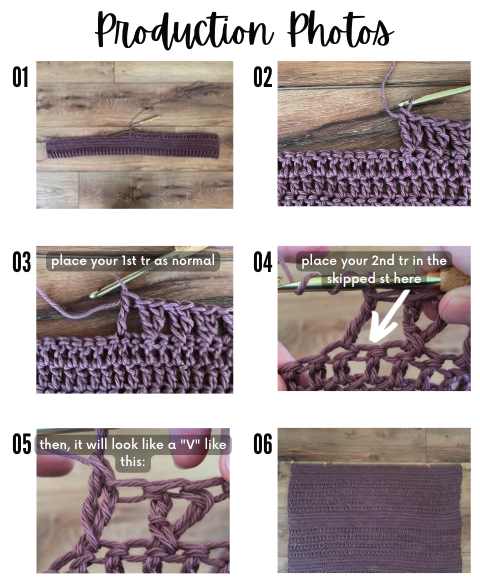
Row 8: sk next st, tr in next st, tr in last skipped st, (sk next st, tr in next st, tr in last sk st) x across, ch 1, turn PHOTO 03-05 shows how to complete the “V” stitch you’re accomplishing during this row. PHOTO 01 & 02 shows middle of row 8 close-up
Row 9: hdc across, ch 2, turn
Row 10-15: repeat rows 8-9 (ending with the hdc row)
Row 16-19: repeat rows 4-7
Row 20-27: repeat rows 8-15
Row 28-31: repeat rows 4-7
Row 32-39: rep rows 8-15, ch 2, turn
At this point, the rest of the body of the cardigan is worked using dc rows. Soon, you will divide the rectangle into 3 sections – 1 for the back and 2 for the front panels. You can easily adjust the length of the cardigan by adding dc rows before you do the dividing as just described.
Row 40-43(45, 46, 48, 49)(51, 52, 54, 55): dc in each st across, ch 2, turn
Divide work into 3 sections for back & front panels: The back will have 54(58, 60, 64, 66)(70, 72, 76, 78) st, each side panel will have 21(22, 24, 25, 27)(28, 30, 31, 33) st PHOTO 06

Panels:
NOTES:
- You will now be working on the 3 panels as divided above
- You will be working turning rows of dc
- Chain 2 and turn at the end of every row – the turning doesn’t count as a stitch
- If you want the cardigan longer, continue to add dc rows to the panels until you find your perfect length
FRONT RIGHT PANEL:
Row 44-53(46-55, 47-57, 49-59, 50-61)(52-63, 53-65, 55-67, 56-69): dc in each st across, ch 2, turn [21](22, 24, 25, 27)(28, 30, 31, 33)
Fasten off. PHOTO 07
BACK PANEL:
Rejoin yarn with a sl st in the next st marker for the back panel and ch 2. When you make your first dc of row 44, remember to dc in the st where you just rejoined the yarn with a sl st.
Row 44-53(46-55, 47-57, 49-59, 50-61)(52-63, 53-65, 55-67, 56-69): dc in each st across, ch 2, turn [54](58, 60, 64, 66)(70, 72, 76, 78)
Fasten off.
FRONT LEFT PANEL:
Rejoin yarn with a sl st in the next st marker for the front left panel and ch 2. When you make your first dc of row 44, remember to dc in the st where you just rejoined the yarn with a sl st.
Row 44-53(46-55, 47-57, 49-59, 50-61)(52-63, 53-65, 55-67, 56-69): dc in each st across, ch 2, turn [21](22, 24, 25, 27)(28, 30, 31, 33)
ASSEMBLY OF THE MAIN BODY RECTANGLE:
- Choose the side you want facing out, they will be very similar and it’s just up to you which side you like the look of better! But don’t stress about it, it’ll look great either way!
- Lay the piece flat and fold the front panels inward to lay on top of the back panel, with the right side facing out.
- Using a length of yarn and a tapestry needle, seam across the shoulders from the outside corner into the center using the whip stitch.
- Fasten off and weave in all ends. PHOTO 08

Ribbed border / collar:
With right side facing out, rejoin yarn at the front bottom corner (right or left, depending on if you’re right-handed or left-handed) and ch 2. PHOTO 09
Row 1: dc up the front edge, around the neck, and back down the opposite front edge – placing 1 dc at the end of each of the hdc rows, 2 dc in the end of the dc rows and 3 dc in the end of the tr rows, ch 2, turn
Row 2: (fpdc in next st, bpdc in next st) x around to the start of the other front edge where you began, ch 2, turn
Row 3: (fpdc in next st, bpdc in next st) x around to the start of the other opposite front edge
Fasten off and weave in end.

Sleeves:
NOTES:
- The sleeves are crocheted directly onto the cardigan.
- The sleeves are made using turning rounds, slip stitching, chaining 2, and turning after each round unless otherwise specified.
- The sleeves should have 40(40, 44, 44, 48)(48, 52, 52, 56) stitches around based on the sleeve opening.
- Check the length of your sleeves as you near the end and add or subtract rows to achieve your desired length.
Rejoin yarn at sleeve opening in the armpit using a sl st and ch 2 (doesn’t count as a st).
Rnd 1: dc in each st around the arm opening, placing 2 dc in the end of each row [40](40, 44, 44, 48)(48, 52, 52, 56)
Rnd 2-3(4, 6, 7, 8)(8, 9, 9, 10): dc in each st around, ch 2, turn [40](40, 44, 44, 48)(48, 52, 52, 56)
Rnd 4(5, 7, 8, 9)(9, 10, 10, 11): dc2tog in next st, dc in each remaining st around, ch 2, turn [39](39, 43, 43, 47)(47, 51, 51, 55)
Rnd 5(6, 7, 9, 10)(10, 11, 11, 12): dc in each st around, ch 2, turn [39](39, 43, 43, 47)(47, 51, 51, 55)
Rnd 6-19(7-20, 8-21, 10-23, 11-24)(11-24, 12-25, 12-25, 13-26): repeat rounds 4 & 5, ch 2, turn [32](32, 36, 36, 40)(40, 44, 44, 48)
Rnd 20(21, 22, 24, 25)(25, 26, 26, 27): dc2tog in next st, dc in each remaining st around, ch 2, turn [31](31, 35, 35, 39)(39, 43, 43, 47)
Finishing Up
Once the second cuff is finished and those last ends are woven in, your Arkose Duster Cardigan is officially ready for its first outing—or for a very pleased lap around the house, which absolutely counts.
This is the kind of handmade layer that can move through several seasons and a surprising number of outfits. If you make your own Arkose, share it on Instagram and tag @offthebeatenhook. I would love to see the yarn and color you choose.


Leave a Reply