
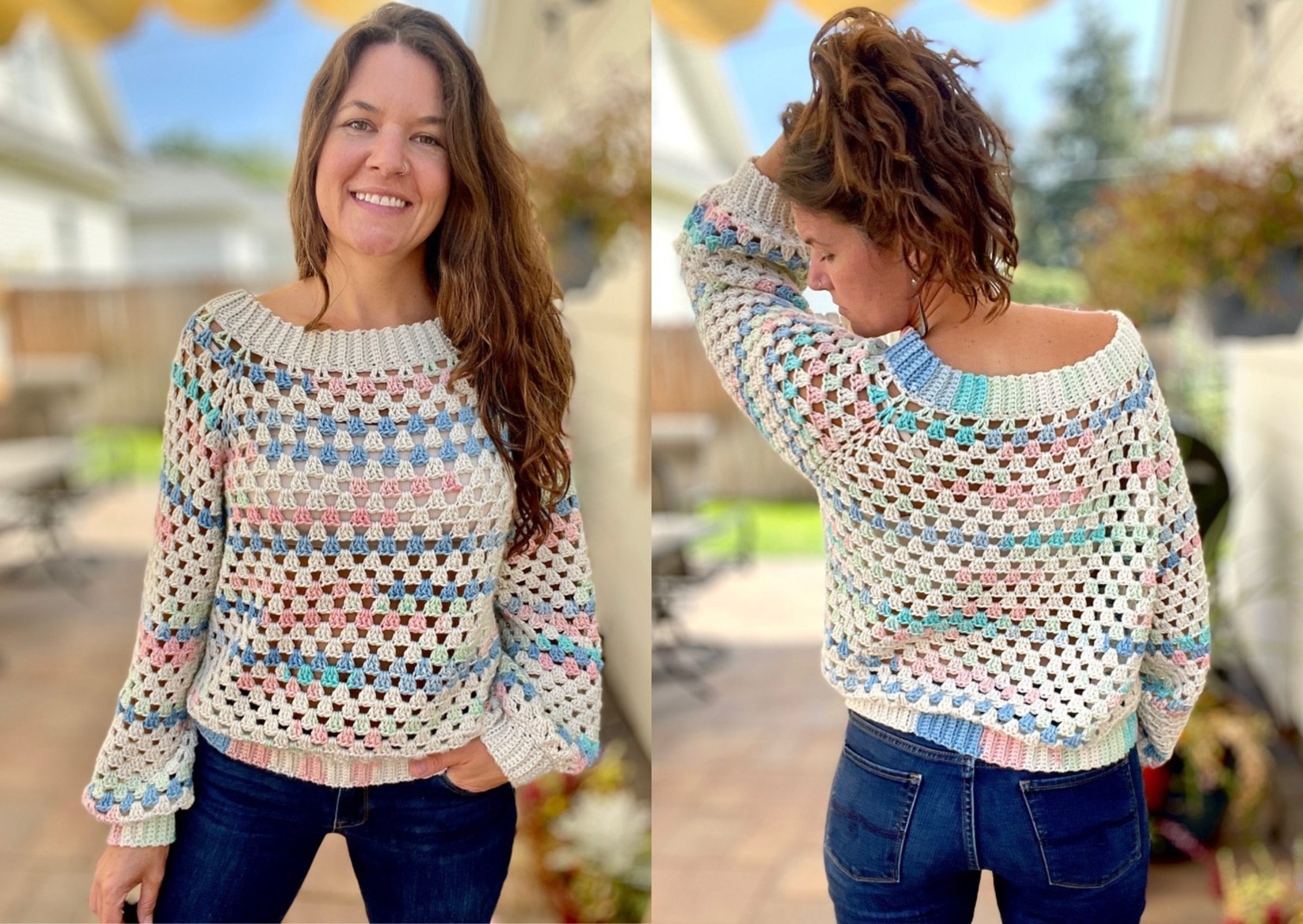
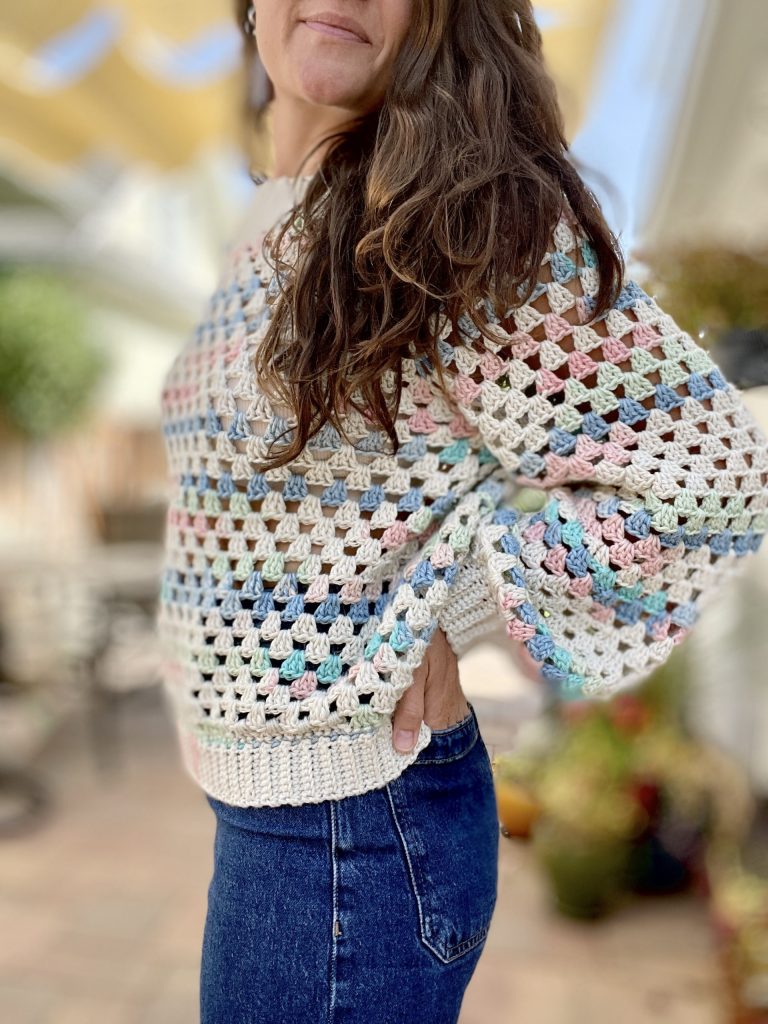
If you’ve been searching for the perfect granny stitch sweater, this is the one you’ll reach for all season long.
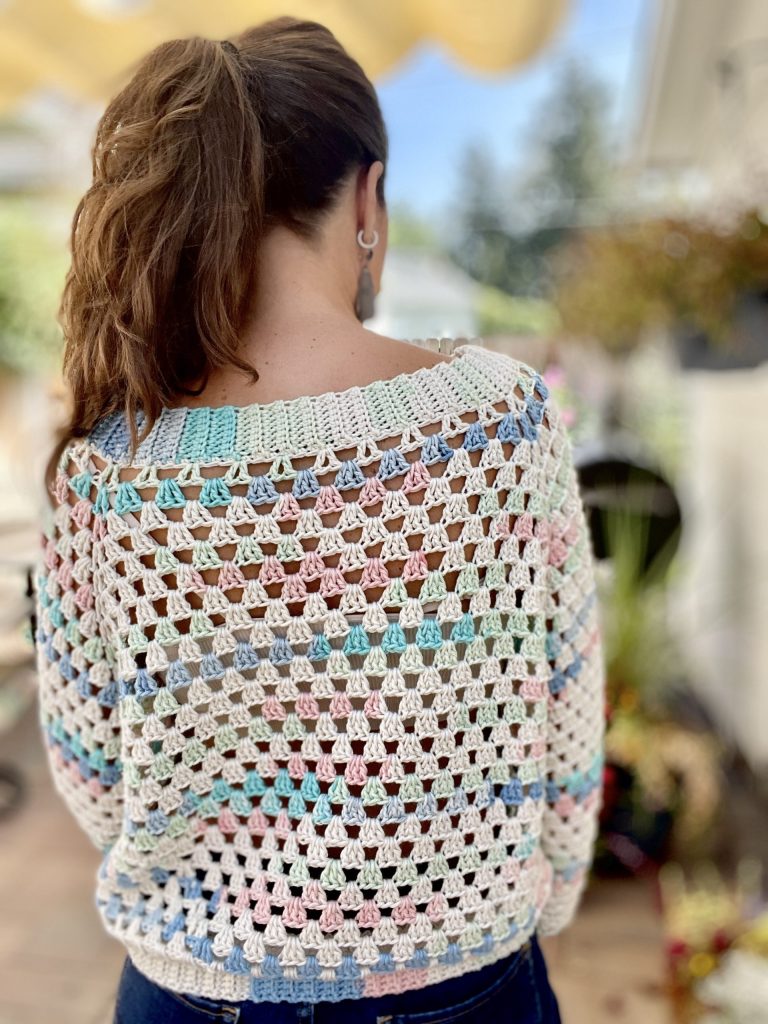
The Isla Granny Stitch Sweater is a lightweight, breathable pullover designed for spring layering, cool mornings, and that in-between weather where you want just a little extra warmth without feeling bulky.
Whether you’re newer to garments or a seasoned maker, this crochet granny stitch sweater is approachable, relaxing, and incredibly wearable.
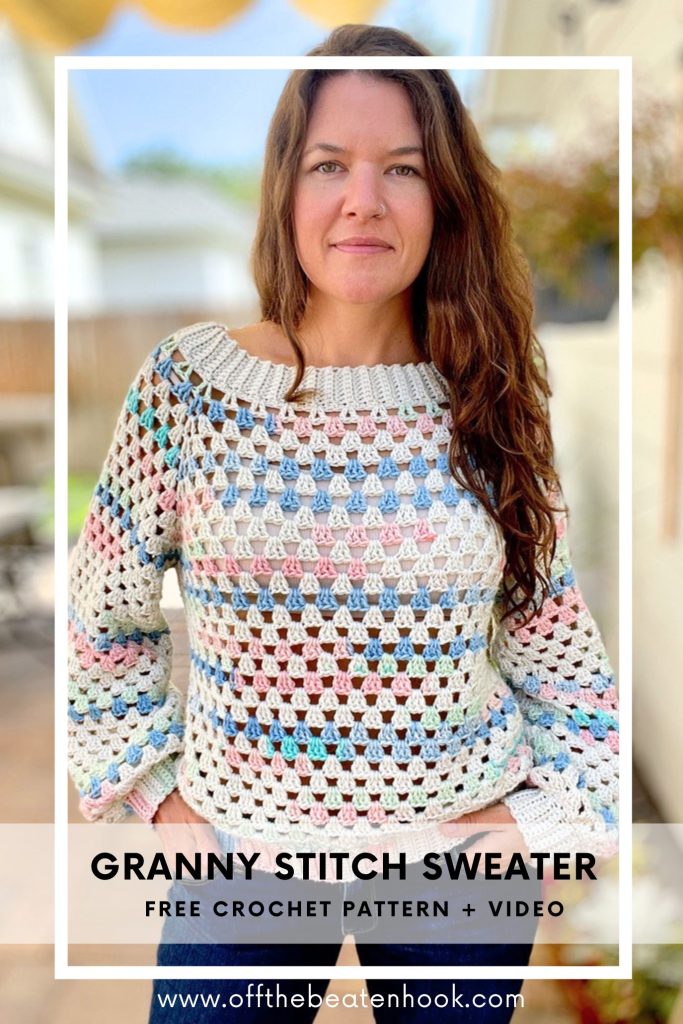
Jump into the granny stitch sweater pattern now, or pin it for later here!
LOVE COLLECTING Patterns?
If you love collecting crochet patterns, you might enjoy my Fiber Love Club — it gives you lifetime access to every pattern I’ve ever designed (plus all future releases).
Instead of buying patterns one by one, unlock the full pattern vault forever in one simple payment.
About the Design
The Isla Sweater uses the classic granny stitch to create an airy fabric that feels effortless and stylish.
It’s constructed in a simple, wearable silhouette that flatters without being complicated—making it a great introduction to garment-making if you’re just getting started.
You’ll find yourself reaching for this sweater again and again… whether you’re heading out the door or curling up with your next project.
Why You’ll Love This Granny Stitch Sweater
- ✨ Lightweight + breathable for spring and summer
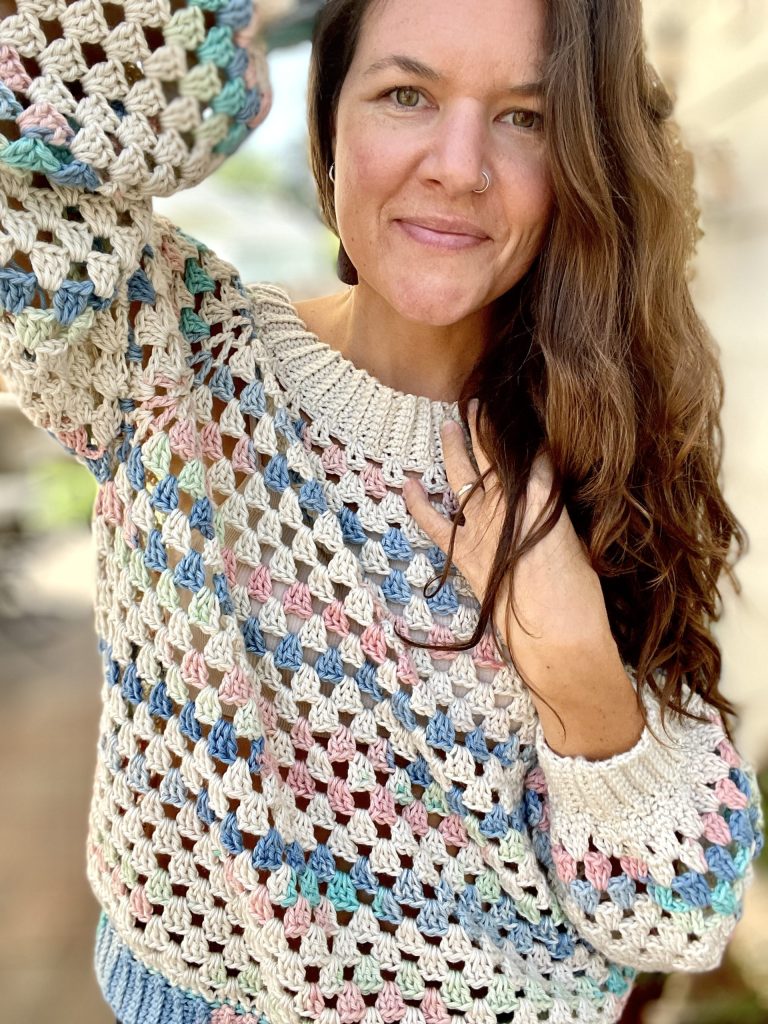
- ✨ Classic granny stitch texture with a modern fit
- ✨ Easy, repetitive stitches (perfect for relaxing crochet time)
- ✨ Designed for layering or wearing on its own
- ✨ Includes a full step-by-step video tutorial
This granny stitch crochet sweater works up beautifully with soft drape and just enough structure to hold its shape.
I’ve created a helpful video tutorial for this pattern as well. You can find that further down in this post or access it straight away on YouTube here.
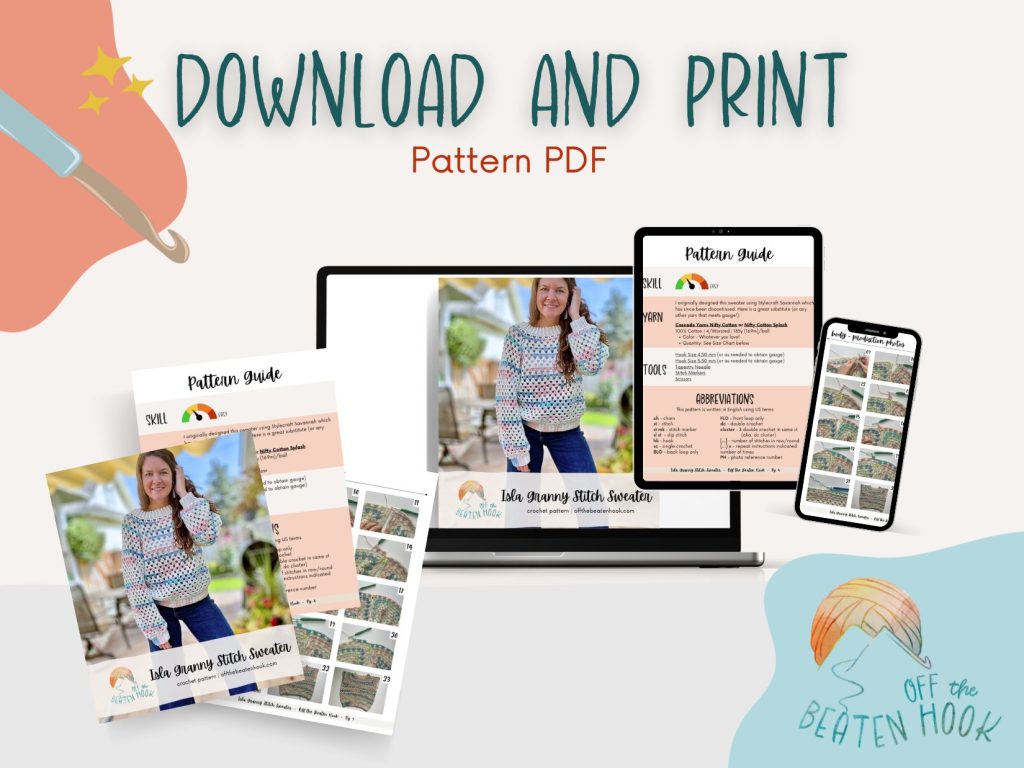
This crochet pattern is reader supported by ads on my blog. If you’d rather print the pattern for some cozy couch crocheting, you can find the ad-free, printable PDF in my shop here or on Ravelry here.
🌿 Eco-Friendly Crafting
What makes this crochet pattern eco-friendly and sustainable?
THE YARN: I use only sustainable and eco-friendly yarn that has been ethically grown/raised and processed, putting the people and the planet first. This is why I chose 100% natural yarn for this pattern.
HANDMADE FOR LONGEVITY: Creating your own sustainable wardrobe pieces promotes mindful consumption. This durable, handmade granny stitch sweater reduces the need for mass-produced alternatives.
THE SLOW YARN MOVEMENT: I’m participating in the Slow Yarn Movement. There’s far too much to talk about here, but please take a few minutes to learn about what this means by reading the article I wrote about the Slow Yarn Movement as part of my 6-part Sustainable Crochet Series.
If you’re interested in learning more about sustainable crochet you can read all about it in the 6-part series I wrote covering everything about Sustainable Crochet and how to implement it into your own crafting starting today!
Materials You Will Need For This Granny Stitch Sweater
Yarn
I originally designed this pattern using Stylecraft Savannah Cotton yarn which I loved! Unfrotunately it’s been pretty off and on with it’s availability, so here are a couple others that I would recommend for this pattern:
I Love This Cotton | 100% Cotton
Lion Brand Mandala Ombre | 100% Acrylic
Cascade Yarns Nifty Cotton or Nifty Cotton Splash
Crochet Hooks needed
Additional Supplies Needed
- Tapestry Needle (bent tips make all the difference!)
- Stitch Markers
- Scissors
- Measuring Tape
Isla Granny Stitch Sweater Video Tutorial:
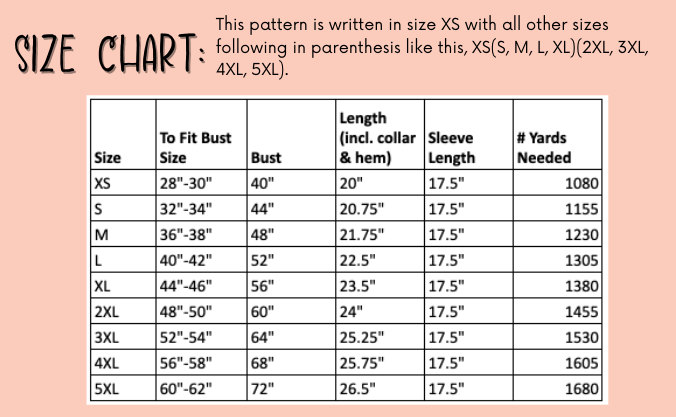
Sizing
Gauge
G
S
Abbreviations Used In The Granny Stitch Sweater
This pattern is written in English, using US terms. If needed, you can find a handy term conversion chart right here in my Resource Library.
ch – chain
st – stitch
hk – hook
sk – skip
sl st – slip stitch
sc – single crochet
dc – double crochet
cluster – 3 double crochet in same st (aka: dc cluster)
BLO – back loop only
FLO – front loop only
rep – repeat
(…) x – repeat instructions indicated number of times
[…] – number of stitches in row/round
PH – photo reference number
Skill Level
Beginner to Advanced Beginner
If you can:
- Chain
- Double crochet
- Work in spaces
…you can make this crochet granny stitch sweater.
FAQ & Terms
Affiliate Links & Ad Support
This post may contain affiliate links. At no extra cost to you, purchases made through these links may earn Off the Beaten Hook a small commission which in no way affects the cost to you. The content on this site is supported by advertisements. By using this site, you agree not to circumvent, block, or tamper with these ads.
Copyright & Intellectual Property
All content on this blog, including free crochet patterns, instructions, charts, photos, videos, and written materials, are the property of Off the Beaten Hook and are protected under copyright and other intellectual property laws. Screenshots or any other method of copying the pattern for offline use or redistribution is prohibited. Sharing patterns in forums, social media groups, or private messages without permission is also prohibited.
Personal Viewing & Use Only
Free patterns published on this site are provided for viewing only on this blog. You may not copy, download, print, take screenshots, or redistribute the pattern in any form (digital or physical) outside this blog. You may not post the pattern or instructions elsewhere online or share it publicly without written consent.
Questions & Permissions
For questions about these permissions or to use or share patterns outside of these rules, please contact Off the Beaten Hook in writing.
Absolutely! You may sell finished items made from Off the Beaten Hook’s patterns, but please credit:
“Pattern by Off the Beaten Hook”
Pattern Support is only available in our Facebook Community group and Video Tutorials. No additional support is provided for modified patterns, alternate yarns, or changes to gauge.
The Isla Granny Stitch Sweater Pattern:
Collar
NOTES:
- The collar is worked in turning rows – ch 1 and turn after every row (ch-1 doesn’t count as a st)
- The collar is the same number of rows for all sizes
- Use the smaller hook size
| Begin by chaining 9 | ||
| Row 1: | beginning in the 2nd ch from the hk, sc in the back bump of the chain and in each ch thereafter, ch 1, turn | [8] |
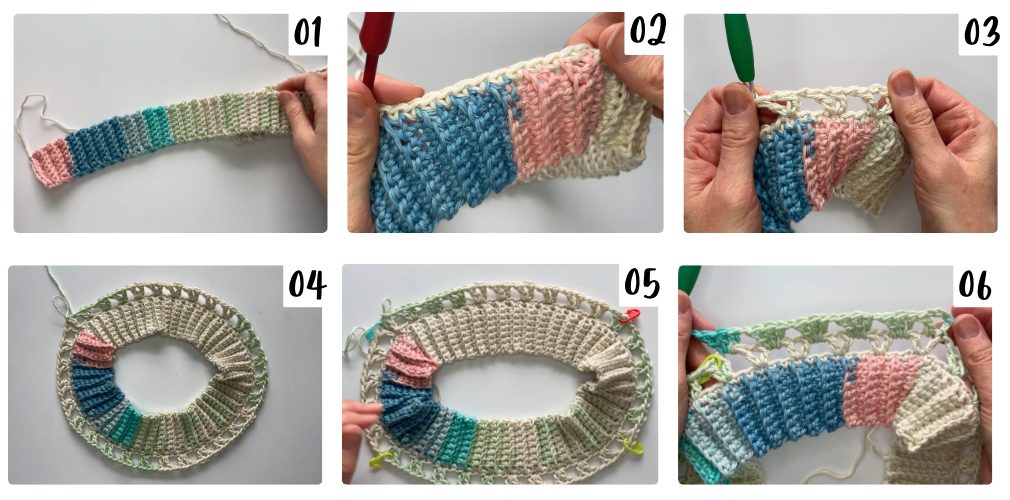
| Row 2-90: | BLO sc in each st across, ch 1, turn | PH 01 | [8] |
| After you complete Row 90, ch 1. | ||
| Join into a circle: Hold the last row and the first row together (there’s no specific right or wrong side at this point). Working through the BLO of the row closest to you and the FLO of the other row, sl st through each st across, ch 1. Your seam will now become the WS of the sweater. | ||
Yoke
NOTES:
- The yoke is worked in joined rounds – do not turn after rounds
- Rnd 1 is made in the same smaller hook size as your collar, then you’ll switch to the larger hook size
- HOW TO MAKE A V STITCH: (dc, ch 1, dc) in same st
- HOW TO MAKE A 3-DC CLUSTER STITCH: make 3 dc in same ch sp
| Rnd 1: | with RS facing out, make one sc at the end of each of the rows of your ribbing, sl st to first st of rnd | PH 02 | [90] |
| Switch to the larger hook size | ||
| Rnd 2: | ch 4 (counts as first dc + ch-1 here and throughout), dc in same st as sl st (first V st made), ch 1, sk 2, *V st in next st, ch 1, sk 2*, repeat from * to * around, ending with a sk 2, sl st into the ch sp of first V st made | PH 03 & 04 | [30 V st’s] |
| Mark the corners with stitch markers: Each of the sleeves will consist of 5 V stitches each. The front and back of the sweater will each consist of 10 V stitches. So, place a st marker into the very first V stitch of the round, and including that one, count a total of 5 V stitches. Place a stitch marker in the next V stitch, and including that one, count 10 V stitche s. Place a st marker into the next V stitch and including that one, count 5 V stitches. Place a st marker into the next V stitch and including that one, count 10 V stitches, which will bring you to the end of the round. You now have all 4 corners marked – PH 05. Move your stitch markers during each round, to keep the corners marked. | ||
| Rnd 3: | ch 4, dc into same st (corner V st made), *ch 1, cluster st in next ch sp, repeat from * across to next corner V st (first sleeve), ch 1, V st into corner V st, *ch 1, cluster st in next ch sp, repeat from * across to next corner V st (front), ch 1, V st into corner V st, *ch 1, cluster st in next ch sp, repeat from * across to next corner V st (second sleeve), ch 1, V st into corner V st, *ch 1, cluster st in next ch sp, repeat from * across to next corner V st (back), ch 1, sl st into the ch sp of first V st [30 clusters + 4 V st’s] | |
| Rnd 4-13(14, 15, 16, 17)(18, 19, 20, 21): Repeat Rnd 3 [see stitch counts per round below] PH 07 | ||
| Each round will increase by 4 clusters total (one cluster per side/section). Here are the stitch counts per round for comparison based on the size you’re making: Rnd 3: 30 clusters + 4 V st’s Rnd 4: 34 clusters + 4 V st’s Rnd 5: 38 clusters + 4 V st’s Rnd 6: 42 clusters + 4 V st’s Rnd 7: 46 clusters + 4 V st’s Rnd 8: 50 clusters + 4 V st’s Rnd 9: 54 clusters + 4 V st’s Rnd 10: 58 clusters + 4 V st’s Rnd 11: 62 clusters + 4 V st’s Rnd 12: 66 clusters + 4 V st’s Rnd 13: 70 clusters + 4 V st’s Rnd 14: 74 clusters + 4 V st’s Rnd 15: 78 clusters + 4 V st’s Rnd 16: 82 clusters + 4 V st’s Rnd 17: 86 clusters + 4 V st’s Rnd 18: 90 clusters + 4 V st’s Rnd 19: 94 clusters + 4 V st’s Rnd 20: 98 clusters + 4 V st’s Rnd 21: 102 clusters + 4 V st’s | ||
Body
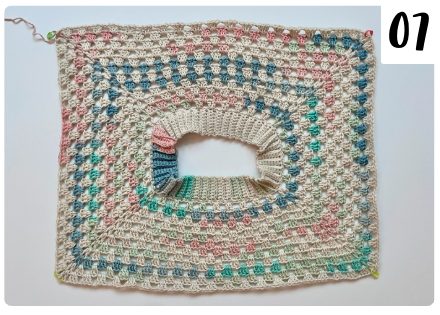
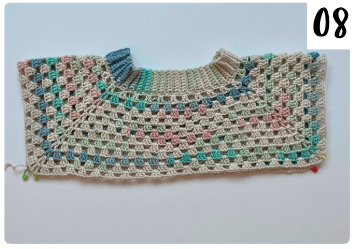
You will now separate the yoke to create the rest of the body and the arm holes for the sleeves. To do so, with the yoke laying flat, and sleeve sections to the right and left side of the rectangle, grab the yoke, pull up, and fold the yoke in half with the front and back (wrong sides) together and the arm openings at the sides – PH 08. Pick up the working yarn right where you left off on the yoke and begin straight away with Rnd 1 of the body. Rnd 1 can be a lot to take in, but take heart! I cover it in detail in the video tutorial for you, so definitely check it out if you need a live visual versus just the photos below!
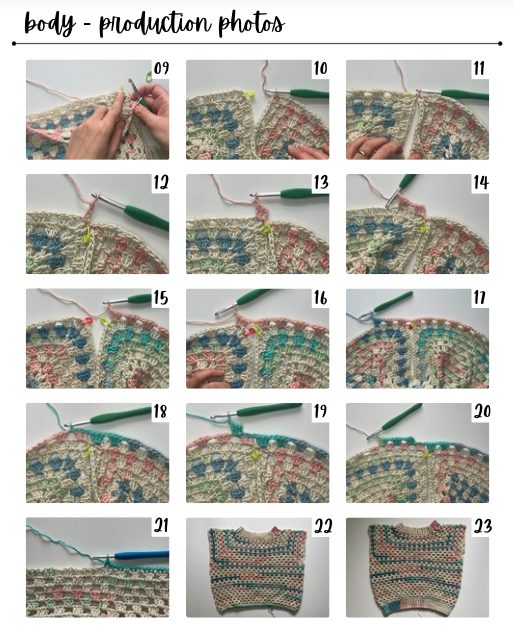
| Rnd 1: | picking up where you left off after completing the yoke, skip over the next sleeve section and make a sl st into the next V st (PH 09 , 10, & 11), sl st into next ch sp, ch 3 (counts as first dc of cluster – PH 12), dc 2 into same space, *ch 1, cluster st in next ch sp (PH 13 & 14), repeat from * across to next corner V st, skip V st, skip next sleeve section, skip next V st (PH 15), 3-dc cluster in next ch sp (PH 16), *ch 1, cluster st in next ch sp, repeat from * across (PH 17), ch 1, sl st to top of first ch-3 to join rnd | |
| Rnd 2: | 3 sl st across to next ch sp (PH 18), ch 3 (counts as first dc of cluster), dc 2 into same space (PH 19), *ch 1, cluster st in next ch sp, repeat from * across (PH 20), ch 1, sl st to top of first ch-3 to join rnd | |
| Rnd 3-17(17, 18, 18, 19)(19, 20, 20, 20): repeat Rnd 2. To modify the length, try on the sweater as you go and continue until you reach the desired length. Feel free to eliminate rows for more of a cropped version, or add rows for a longer, tunic length! | ||
| Switch to the smaller hook size | ||
| Rnd 18(18, 19, 19, 20)(20, 21, 21, 21): ch 1, sc around, making 1 sc in the top of each of the dc st only – skip over all the ch spaces, sl st to first sc to join | PH 21 & 22 | ||
Ribbed Hem
| Begin by chaining 9 | ||
| Row 1: | beginning in the 2nd ch from the hk, sc in the back bump and in each ch thereafter, sl st in next 2 st along body, ch 1, turn | [8] |
| Row 2: | skipping the ch and both sl st’s, BLO sc in next 7 st, sc through both loops of final st, ch 1, turn | [8] |
| Row 3: | sc through both loops of the first st, BLO sc in next 7 st, sl st in next 2 st on last rnd of body, ch 1, turn | [8] |
| Row 4+: | repeat rows 2 and 3 all the way around the hem of the sweater | [8] |
| Holding the first and last row of ribbing with right sides together, sl st the ribbing together across all 8 stitches. Fasten off and weave in end. PH 23 | ||
Sleeves
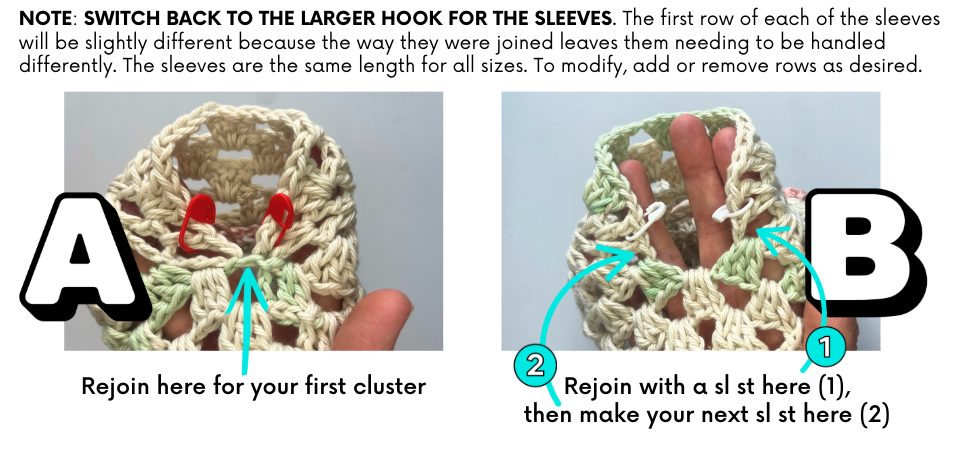
For armpit “A”:
Identify your 2 V stitches at the armpit. Slip knot onto your hook.
| Rnd 1: | rejoin with a sl st into the gap between the V stitches and ch 3 (counts as first dc of cluster), 2 dc in same space, skip over V st, *ch 1, cluster st in next ch sp, repeat from * across to next V st, skip V st, sl st to beginning ch 3 to join round | |
| Rnd 2: | 3 sl st across to next ch sp, ch 3 (counts as first dc of cluster), dc 2 into same space, *ch 1, cluster st in next ch sp, repeat from * across, ch 1, sl st to top of first ch-3 to join rnd | |
| Rnd 3-26: | repeat Rnd 2 | |
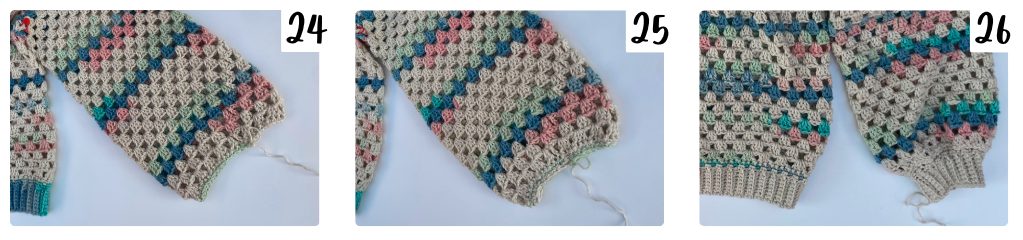
| Rnd 27: | ch 1, sc around, making 1 sc in the top of each of the dc st only – skip over all the ch spaces, sl st to first sc to join | PH 24 | |
| Rnd 28: | ch 1, (sc 1, dec) x around, sl st to join | PH 25 | |
| Sleeve cuffs – switch to the small hook size and chain 9: | ||
| Row 1: | sc in 2nd ch from hk and next 7 st, sl st in next 2 st on last rnd of sleeve, ch 1, turn | [8] |
| Row 2: | skipping the ch and both sl st’s, BLO sc in next 7 st, sc through both loops of final st, ch 1, turn | [8] |
| Row 3: | sc through both loops of the first st, BLO sc in next 7 st, sl st in next 2 st on last rnd of sleeve, ch 1, turn | [8] |
| Row 4+ | repeat rows 2 & 3 all the way around cuff | PH 26 | [8] |
| Holding the first and last row of ribbing with right sides together, sl st the ribbing together across all 8 stitches. Fasten off and weave in end. | ||
For armpit “B”:
Identify your 2 V stitches at the armpit. Slip knot onto your hook.
| Rnd 1: | rejoin with a sl st into the gap next to the the V stitch**, sl st into the gap next to the other V st and ch 3 (counts as first dc of cluster), 2 dc in same space, skip over V st, *ch 1, cluster st in next ch sp, repeat from * across to next V st, skip V st, sl st to beginning ch 3 to join round | |
| Rnd 2+: | repeat method for first sleeve | |
**For right handed, this will be the gap to the left of the V st on the right side of the arm opening. For left handed, this will be the gap to the right V st on the left side of the arm opening.
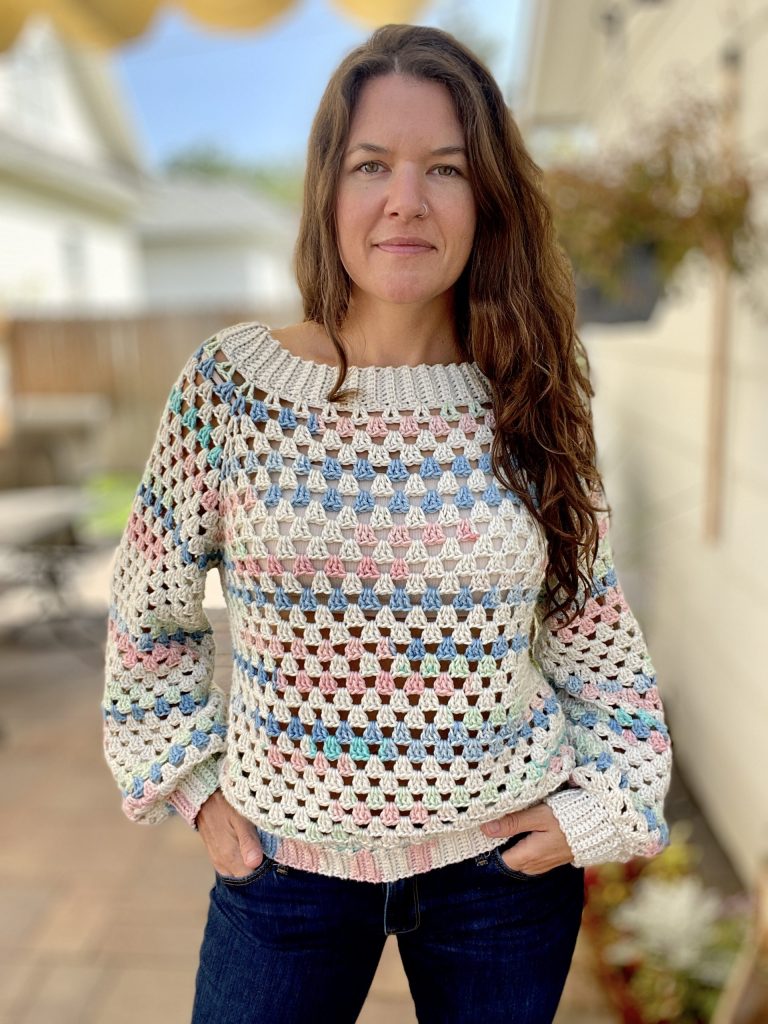
How to Style Your Granny Stitch Sweater
This piece was designed to be versatile:
- Layer it over a tank or dress
- Pair it with jeans for everyday wear
- Throw it on during cool spring mornings
- Use it as a lightweight summer layer
It’s one of those pieces that feels handmade—but still effortlessly wearable.
I can’t wait to see your beautiful granny stitch sweaters! Be sure to tag me on social media @offthebeatenhook or use the hashtag #offthebeatenhook so I can admire your makes. ❤️
🔗 Other Cozy Patterns To Check Out:
- Mt Rainier Pullover Sweater
- Nivelle Cowl Neck Sweater
- Solara Hoodie
- Hoodoo Classic Cardigan
- Airie Granny Square Cardigan
SOCIAL MEDIA YOUR THING?
Connect with me on your favorite social network!
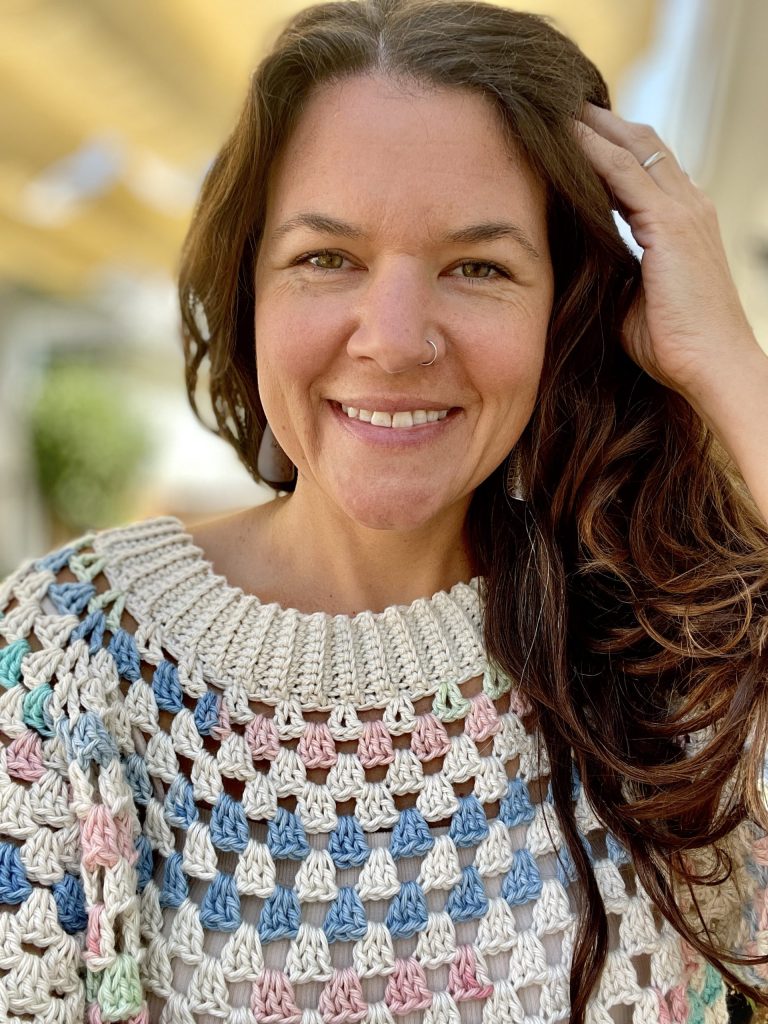
Pin this granny stitch sweater pattern here:
Leave a Reply