
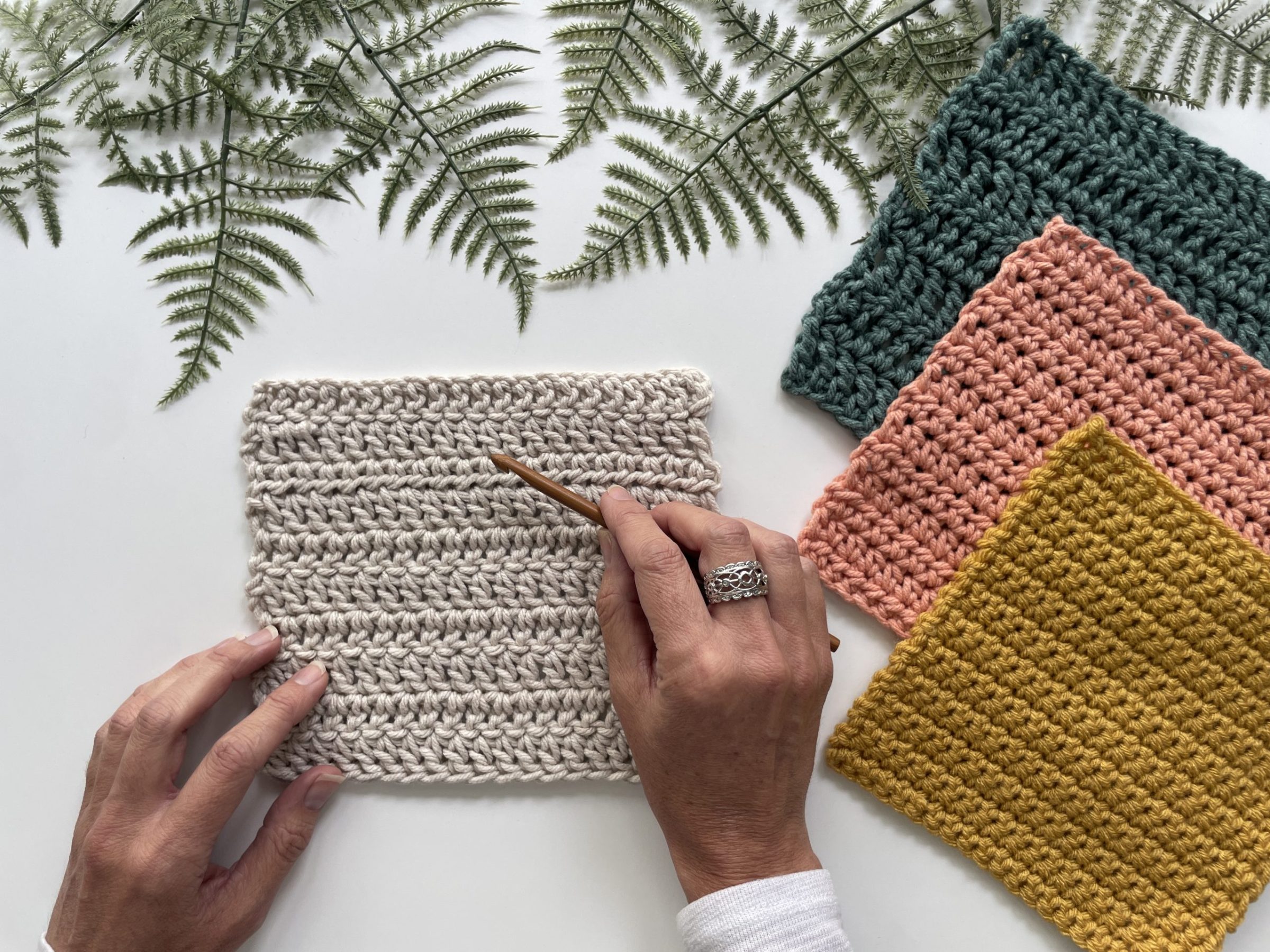
Learning how to double crochet opens the door to taller stitches, faster-growing projects, and a whole new collection of crochet patterns.
The double crochet stitch is one of the most commonly used basic crochet stitches. It’s taller than both single crochet and half double crochet, which means it creates a softer, more flexible fabric—and lets you cover quite a bit of ground without crocheting until the end of time.
In this beginner-friendly lesson, I’ll show you exactly how to do a double crochet stitch, how to work double crochet in rows, and how to recognize and count your stitches. We’ll also cover a few common mistakes so you’ll know what to look for if your practice swatch starts developing a personality of its own.
LEARN TO crochet
Module 2: Core Crochet Stitches
Lesson 4: How to Double Crochet
This lesson is part of my free Learn to Crochet Course designed to take you from your very first stitch to completing your first projects and beyond.
24 step-by-step lessons with videos.

Materials You Will Need For This Lesson
- Worsted (4/Medium) Weight Yarn
- 5.5 mm Crochet Hook (a size 5.0 mm or 6.0 mm will work, if preferred)
- Scissors
- Yarn Needle
- Stitch Markers
A Little Help for Your Crochet Basket
Join and get the free Crochet Pro Essentials PDF Pack, plus gentle course reminders and new lessons in your inbox.
What Is a Double Crochet Stitch?
The double crochet is a tall basic crochet stitch made by wrapping the yarn over your hook before inserting it into the stitch.
Once your hook is inserted, you’ll pull up a loop and then work through the loops on your hook two at a time. This creates the double crochet’s recognizable tall post.
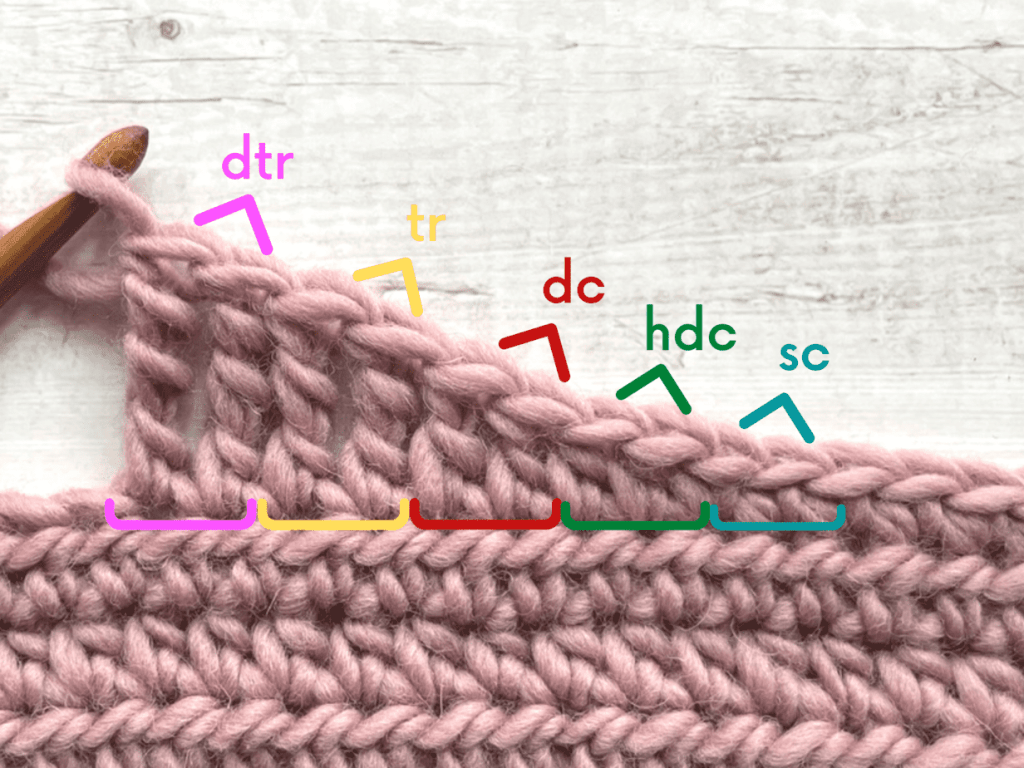
Because double crochet stitches are taller than single and half double crochet stitches, they create fabric that is:
- Softer and more flexible
- More open and drapey
- Quicker to work up
- Great for blankets, scarves, garments, shawls, and granny squares
Double crochet is abbreviated as dc in written crochet patterns using US terminology.
A quick terminology note: a US double crochet is called a treble crochet (tr) in UK terminology. Throughout this lesson, I’ll be using standard US crochet terms.
What Can You Make With Double Crochet?
Double crochet is used in an enormous variety of projects, including:
- Blankets and afghans
- Scarves and cowls
- Sweaters and cardigans
- Shawls
- Hats
- Bags
- Granny squares
- Home décor
Its height makes it faster to work than shorter stitches, while its flexibility creates lovely drape. You’ll also find double crochet used as the foundation for many textured stitches, lace patterns, and stitch combinations.
In other words, this is one of those stitches you’ll use again and again.
How to Double Crochet Step by Step
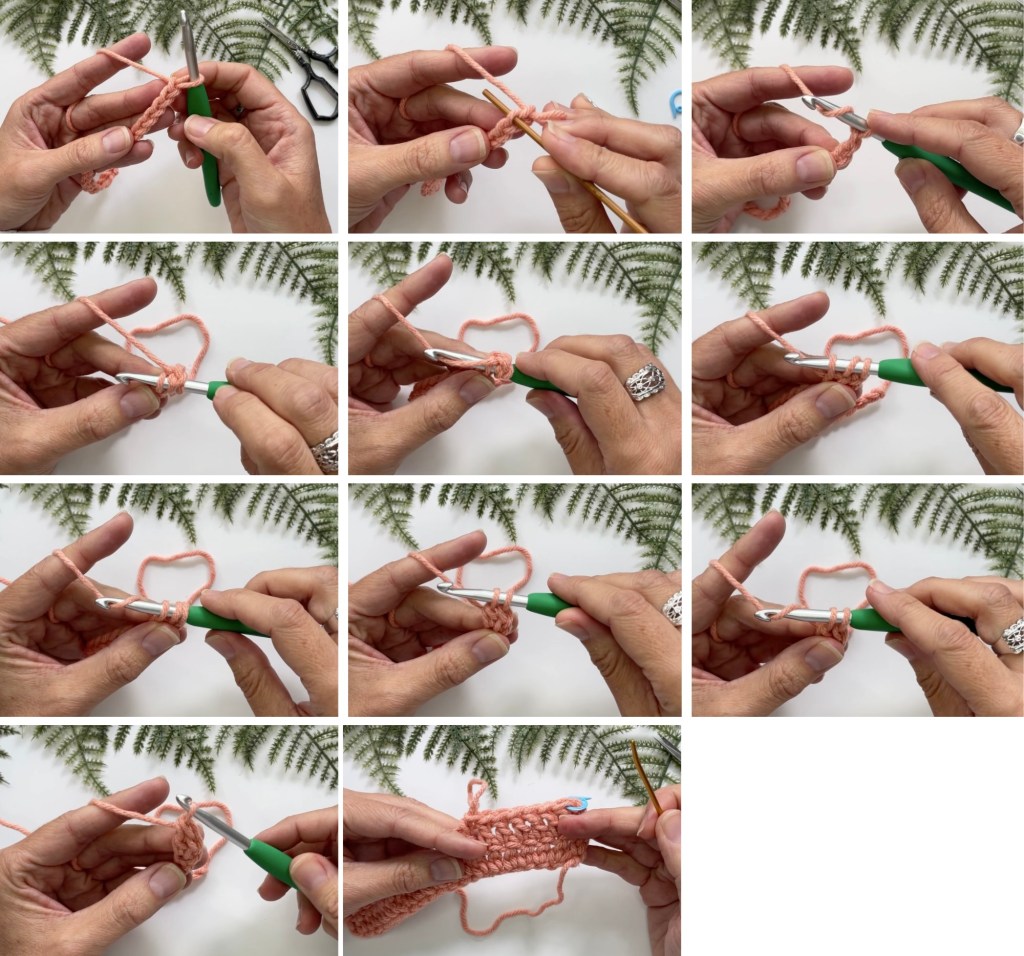
The double crochet stitch is made with these simple steps (photos below):
- Yarn over.
- Insert your hook into the stitch.
- Yarn over again.
- Pull up a loop. You should now have three loops on your hook.
- Yarn over again and pull through only 2 loops on your hook.
- Yarn over again and pull through the remaining 2 loops on your hook.
That’s one double crochet complete.
How to Double Crochet into a Foundation Chain
To make a small practice swatch:
- Make a slip knot.
- Chain 22.
- Yarn over.
- Insert your hook into the third chain from the hook.
- Complete one double crochet.
- Work one double crochet into each remaining chain across.
You should have 20 double crochet stitches.
For this practice swatch, the two skipped chains create the height needed to begin the row, but they do not count as a stitch. When you begin working from written patterns, always check the pattern instructions. Some designers use a chain two at the beginning of a double crochet row, while others use a chain three. The turning chain may or may not count as a stitch. We will talk more about this turning chain later.
There isn’t one universal rule here, because apparently crochet needed to keep us humble. Follow the instructions given in the specific pattern you’re using.
How to Work the Second Row of Double Crochet
Once you’ve completed your first row:
- Chain two.
- Turn your work.
- Yarn over.
- Insert your hook into the first stitch.
- Complete one double crochet.
- Work one double crochet into every stitch across.
Because the turning chain does not count as a stitch in this practice swatch, you’ll work your first double crochet into the very first stitch.
At the end of the row, count your stitches. You should still have 20.
Repeat these steps for as many rows as you’d like. Practicing several rows will help you become comfortable with the movement while also teaching you how to recognize and count double crochet stitches.
How To Double Crochet Video Lesson
An Even Closer Look at Each Step
1.Yarn over hook from back to front
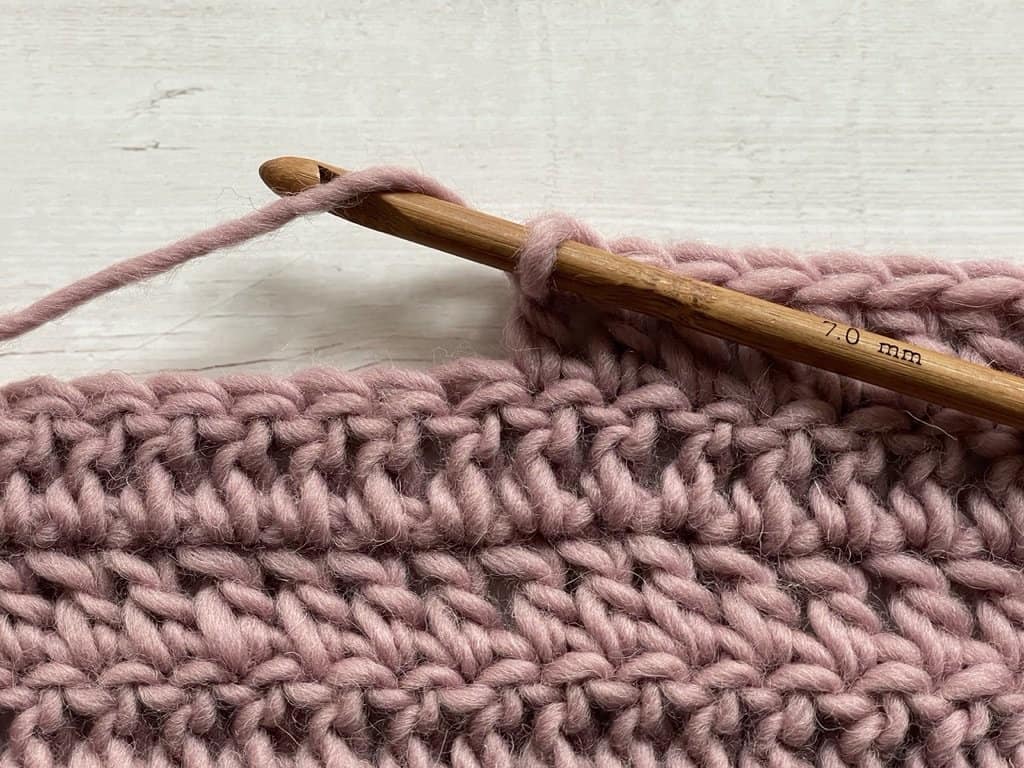
2. Insert the hook into the next stitch

3. Yarn over and pull up a loop (you now have 3 loops on your hook)

4. Yarn over again
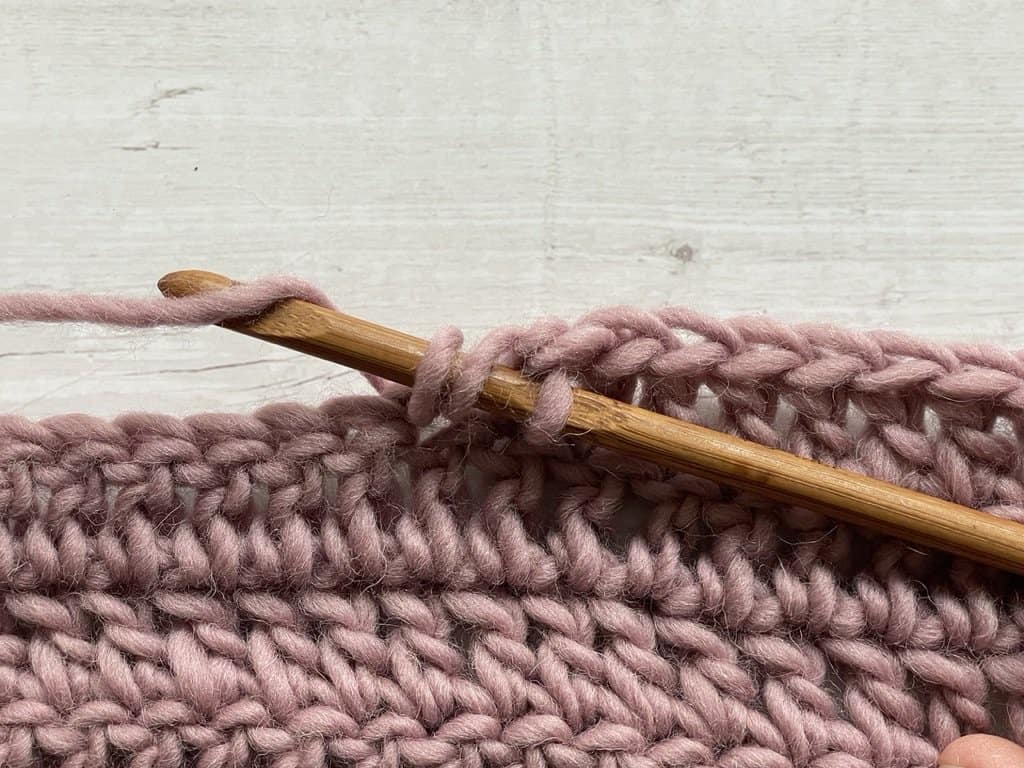
5. Pull through 2 loops on the hook (you now have 2 loops left on the hook)
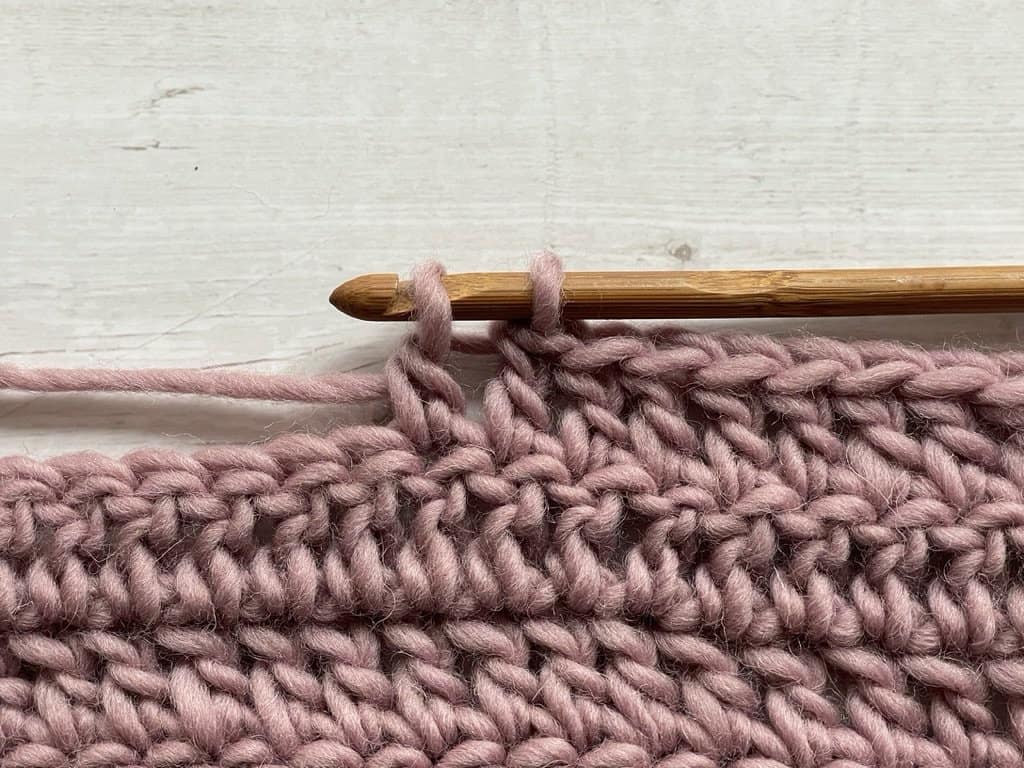
6. Yarn over again
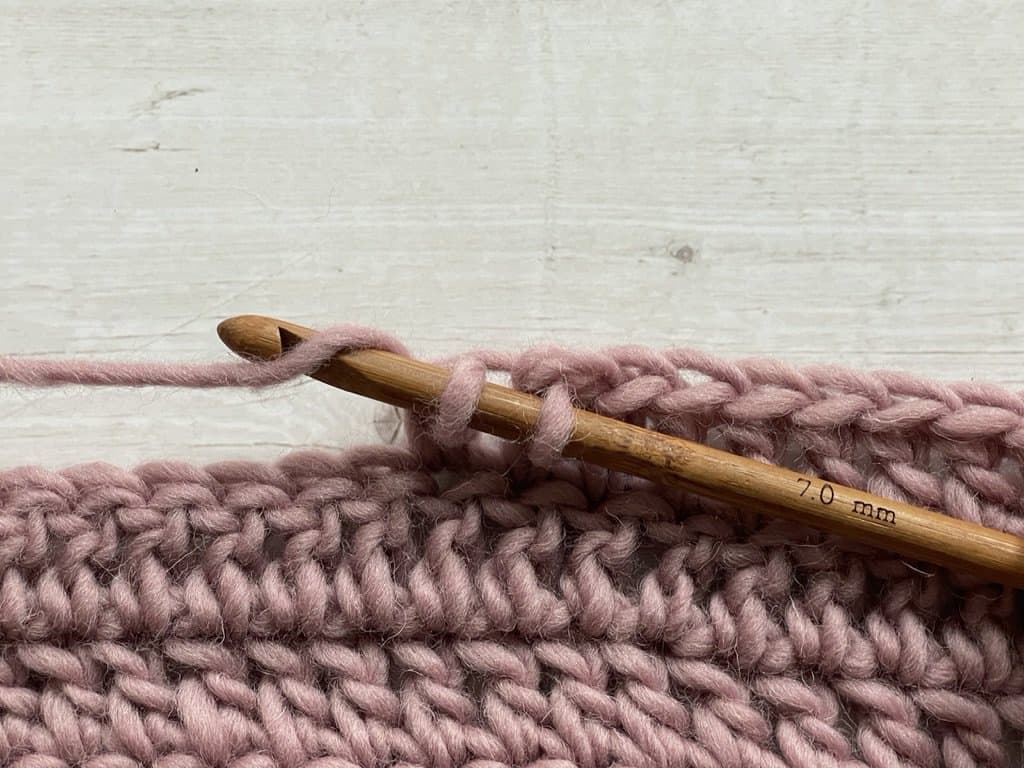
7. Pull through final 2 loops on the hook

How to Recognize a Double Crochet (Stitch Anatomy)
When you look at the top of your work, each double crochet stitch has two loops that form a small V.
Unless a pattern tells you otherwise, insert your hook underneath both loops of that V.
The tall vertical section below the V is called the post of the stitch. Double crochet stitches have noticeably taller posts than single or half double crochet stitches, making them fairly easy to recognize once you know what you’re looking for.
When you reach the end of a row, pause and check that you haven’t skipped the final stitch. The last stitch can lean toward the edge and hide beside the turning chain like it has somewhere else to be.
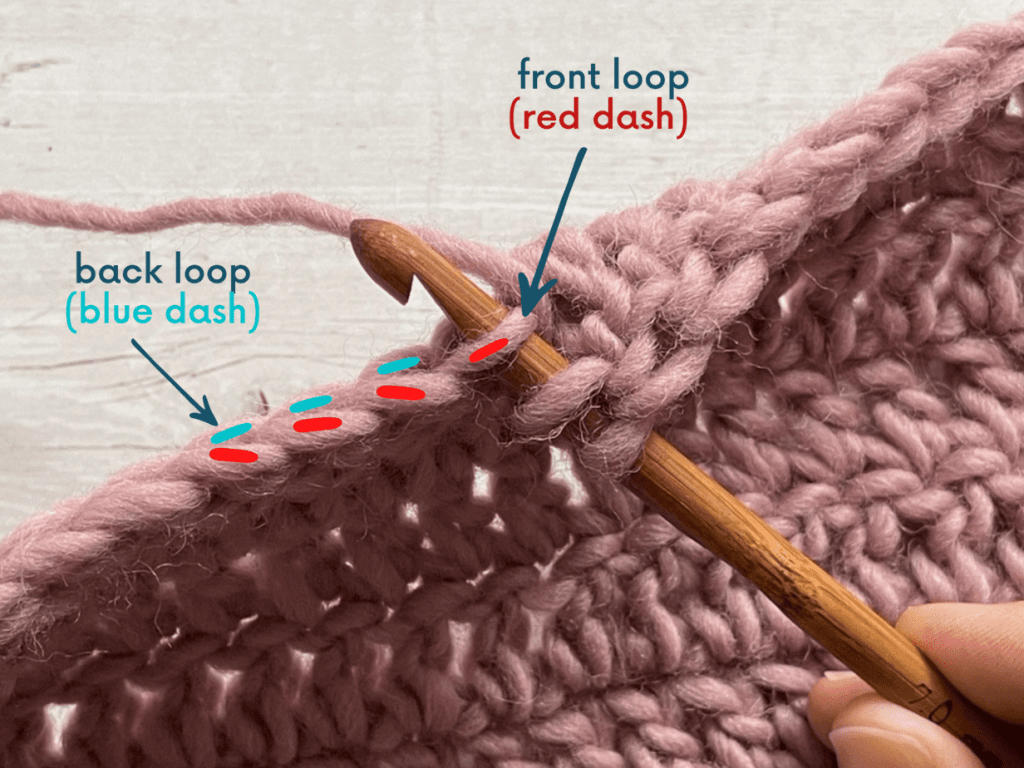
Front Loop Only
When reading a crochet pattern that calls for working in the front loop only, the abbreviation you will see for DOULBE CROCHET FRONT LOOP ONLY IS: DC FLO. Here is how it looks when you crochet under the front loop only:
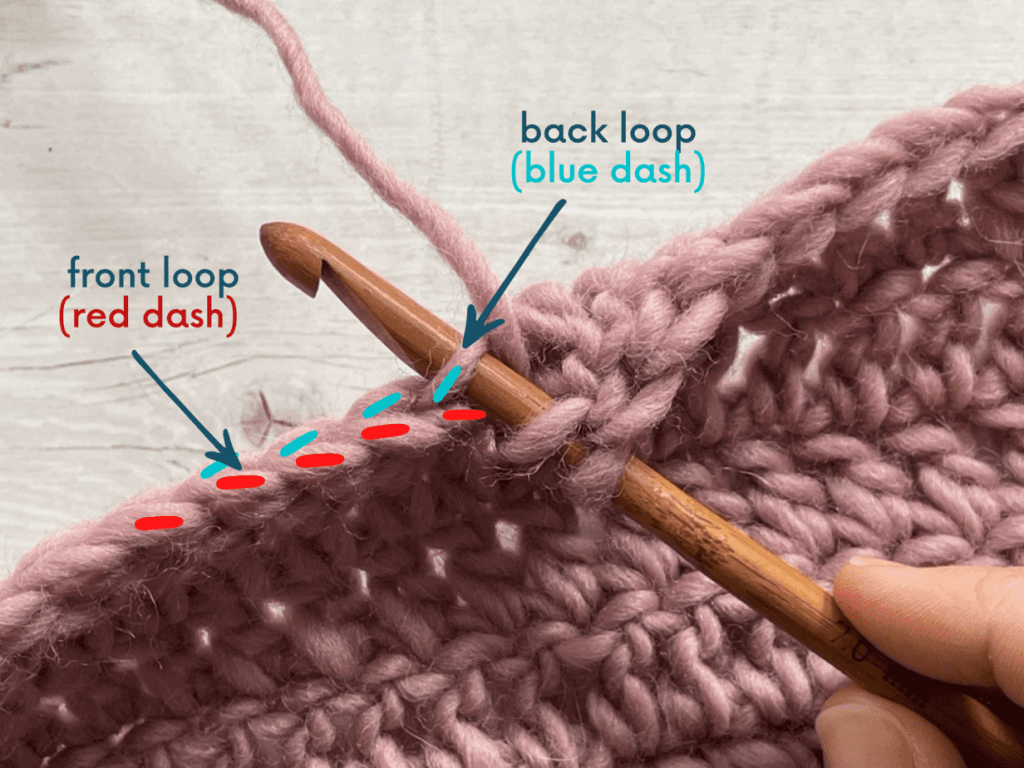
Back Loop Only
When reading a crochet pattern that calls for working in the back loop only, the abbreviation you will see for DOULBE CROCHET BACK LOOP ONLY IS: DC BLO. Here is how it looks when you crochet under the back loop only:
How to Make a Double Crochet Increase
A double crochet increase is when you make more than one dc into the same stitch. You can make 2, 3 or more dc into the same stitch too! In a pattern, the dc increase will be abbreviated DC INC.
- Yarn over hook
- Insert your hook into the next stitch
- Yarn over and pull up a loop (you now have 3 loops on your hook)
- Yarn over again and pull through 2 loops on your hook (you now have 2 loops left on your hook)
- Yarn over again and pull through final 2 loops on your hook
- Repeat steps 1-5 into the same stitch for as many times as required

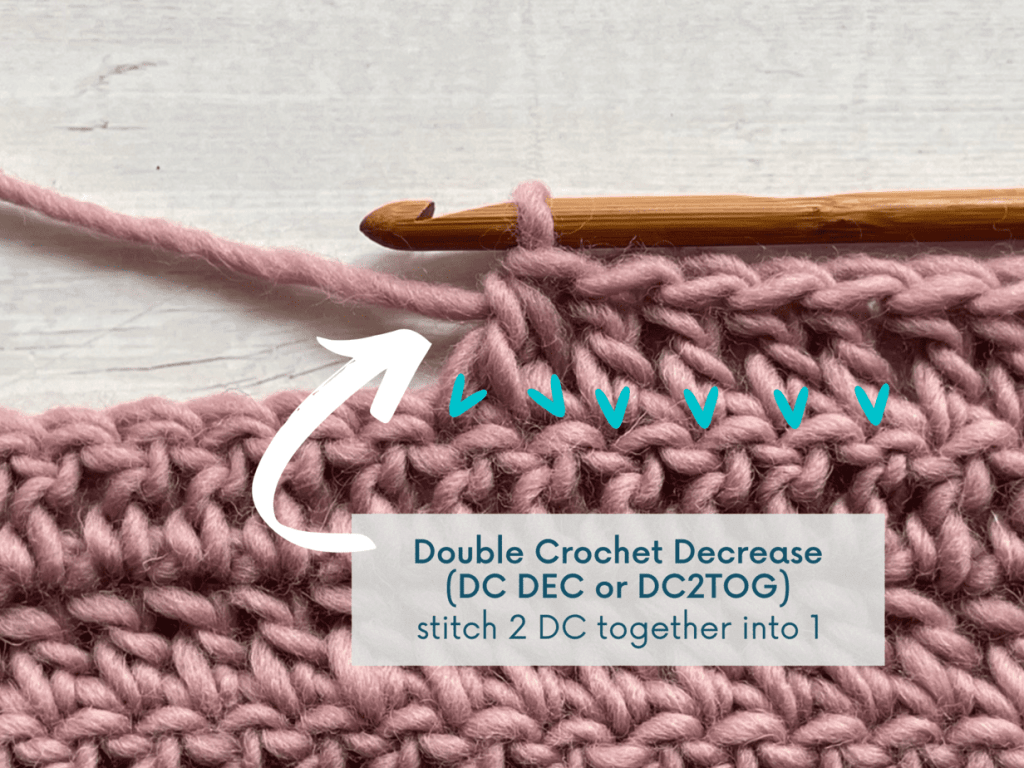
How to Make a Double Crochet Decrease
A double crochet decrease is when you stitch 2 (or more) dc stitches together into one. In a pattern, the dc decrease will be abbreviated DC DEC or DC2TOG which stands for “double crochet 2 together”.
- Yarn over hook
- Insert your hook into the next stitch
- Yarn over and pull up a loop (you now have 3 loops on your hook)
- Yarn over and insert your hook into the next stitch
- Yarn over and pull up a loop (5 loops on your hook)
- Yarn over and pull through 3 loops
- Yarn over again and pull through final 3 loops on your hook
What About the Double Crochet Turning Chain?
A turning chain is a number of chain stitches that you make at the beginning of a row to ensure your next row is brought up to the correct height to match the height of the stitch you are making.
There are two ways to make a turning chain for dc. It is important to know the difference here because one version counts the turning chain as your first dc stitch of the row and one does not. So, let’s talk about this. Ultimately, if you’re making a pattern, you’ll want to follow what the designer instructs on how to treat the chain.
When making a turning chain for dc you will either chain ONE, TWO or THREE (chaining only ONE is uncommon, but not unheard of). When you only chain ONE or TWO, the turning chain does NOT count as a stitch. In this case you will make your first dc of the row in the very first available stitch. As a result, the turning chain will add a minor amount of bulk to the first stitch but doesn’t leave as much of a gap at the end of the row. You will make your last dc of the row in the first dc of the previous row. This is my preferred method of the dc turning chain because I hate inconsistent gaps!
When a dc turning chain consists of THREE chains, it DOES count as your first dc of the row. In this case, you will skip the first stitch of the row (referred to as a “false stitch”) and make your first dc in the 2nd stitch in. As a result, you will see a larger gap between the turning chain stitch and the second stitch of the row than there is between all the other stitches of the row. When you come to the end of the row you will make your final dc of the row into the top of the turning chain from the previous row.

How to Count Double Crochet Stitches and Rows
To count your stitches, look across the top edge of your work and count each V.
You can also count the tall vertical posts across the row. Each post represents one double crochet stitch.
Do not count the loop currently on your hook as a stitch.
To count your rows, look for the horizontal groups of double crochet posts stacked on top of one another. Each group represents one completed row.
Counting at the end of every row is one of the easiest ways to keep your practice swatch—and eventually your projects—from becoming wider or narrower.
If you’re consistently losing or gaining stitches, place a stitch marker in the first and last stitch of each row. This makes the edges much easier to identify.

Double Crochet Tension Tips
Try to keep your hands relaxed while practicing. Your hook should move easily through the loops without needing to tug, yank, or negotiate with the yarn.
If your stitches feel too tight:
- Relax your grip on the hook and yarn.
- Try not to pull the working yarn after every step.
- Make sure your loops remain on the wider shaft of the hook rather than tightening around the narrow tip.
- Consider trying a slightly larger hook.
If your stitches feel too loose:
- Keep gentle, consistent tension on the working yarn.
- Avoid pulling your loops unusually high.
- Consider trying a slightly smaller hook.
Your first stitches may not all be identical, and that is completely normal. Consistent tension develops through repetition—not by gripping everything harder and hoping for the best.
Common Double Crochet Mistakes
Starting with the wrong number of loops
After you yarn over, insert your hook, and pull up a loop, you should have three loops on your hook.
If you have only two, you may have forgotten the first yarn over. That will create a half double crochet instead of a double crochet.
Pulling through all three loops at once
For a double crochet, pull through two loops and then pull through the remaining two loops.
Pulling through all three loops at once creates a half double crochet.
Skipping the first stitch
Whether you work into the first stitch depends on whether the turning chain counts as a stitch. In our practice swatch, the turning chain does not count, so you’ll work into the first stitch.
Always check your pattern’s instructions.
Missing the final stitch
The last stitch of the row can be easy to overlook, especially near the turning chain. Count your stitches before beginning the next row.
Adding an extra stitch
If the turning chain does not count as a stitch, don’t work into it at the end of the row. Doing so will add an extra stitch and gradually make your swatch wider.

How to Double Crochet FAQs
Double crochet is abbreviated as dc in patterns written with US crochet terminology.
Yes! Double crochet has a few more steps than single crochet, but the repeated “pull through two, pull through two” motion is easy to remember with practice.
Both stitches begin with a yarn over. For half double crochet, you pull through all three loops on the hook at once. For double crochet, you pull through two loops at a time.
This extra step makes the double crochet taller than the half double crochet.
A double crochet turning chain is commonly two or three chains tall. Whether it counts as the first stitch depends on the pattern and the designer’s preferred method.
For the practice swatch in this lesson, we use a chain two that does not count as a stitch.
Uneven edges are usually caused by adding or skipping stitches at the beginning or end of a row. Count your stitches regularly and consider marking the first and last stitch.
Double crochet is a tall stitch, so small spaces between the posts are normal. Your turning-chain method can also create a slightly larger gap at the edge of a row.
No. A US double crochet is called a treble crochet in UK terminology. A UK double crochet is the same stitch as a US single crochet.
Always check which terminology a pattern uses before you begin.
Double Crochet Practice Challenge
Use these simple instructions to practice everything from this lesson:
Foundation chain: Chain 22.
Row 1: dc in the third chain from the hook and in each chain across. You should have 20 stitches.
Row 2: Chain 2 and turn. The chain 2 does not count as a stitch here and throughout. Dc in the first stitch and in each stitch across. You should have 20 stitches.
Repeat Row 2 until you feel comfortable with the stitch or your swatch is approximately square.
When you’re finished, fasten off and save the swatch. Keeping your practice pieces gives you a handy stitch reference—and proof that your hands are learning even when a new stitch still feels awkward.
You Know How to Double Crochet!
You now know how to make a double crochet, work it across a foundation chain, turn your work, and continue crocheting in rows.
Your hands are learning something new. Slightly wonky practice swatches are simply part of the process.
In the next lesson, we’ll build on what you’ve learned and tackle the treble crochet stitch, an even taller stitch that follows a very similar rhythm.
You’re doing beautifully—keep going!
← Previous Lesson: How to Half Double Crochet
SOCIAL MEDIA YOUR THING?
Connect with me on your favorite social network!
Pin This Lesson for Later

Leave a Reply