
Did you know that the skeins of yarn sitting in your craft closet hold more than just colorful potential? Beyond the vibrant hues and inviting textures lies a hidden world of certifications that impact the authenticity, ethics, and environmental sustainability of the yarns we love. In this article, I will dive into the often overlooked realm of sustainable yarn certifications and explore why they matter more than you might think. I will cover 5 of the most common certifications.
By understanding these certifications, you can make informed choices, support ethical production, and contribute to the growth of a sustainable yarn industry. So, the next time you pick up a skein, remember to look beyond the surface and pay attention to those little labels that hold immense value.
Understanding Yarn & Textile Certifications
To ensure the authenticity of the yarn you’re purchasing, it’s essential to understand the significance of yarn fiber certification labels. These labels provide valuable information about the origin, qualities, and production practices associated with the yarn, allowing you to make informed choices and support ethical and sustainable practices within the industry. By delving into the details behind these certifications, you can go beyond the surface of the yarn and truly understand its story.
So, let’s look at 5 of the most common sustainable yarn certifications. I present these in no particular order – they’re all incredibly important!
#1: OEKO-TEX STANDARD 100
OEKO-TEX consists of 17 independent research and test institutes in Europe and Japan who work together to develop test methods for the textile and leather industry. Their goal is to create trust in textiles through increased product safety, sustainable production and transparency. They have several different certifications that a textile can achieve.
Their most well known certification is their OEKO-TEX STANDARD 100 which means that the textile has been tested for harmful substances and is harmless for human health. This is probably the most common label I’ve seen on yarn.

I’m even more impressed by their OEKO-TEX MADE IN GREEN certification which not only assures that the textile is made of materials that have been tested for harmful substances, but also assures that the product has been manufactured in environmentally friendly facilities under safe and socially responsible working conditions. Also, that the supply chain is traceable and transparent. Love it.

#2: GOTS – Global Organic Textile Standard
The Global Organic Textile Standard (GOTS) is the worldwide leading textile processing standard for organic fibers. I highly respect this certification because it’s requirements are extensive – beginning with the harvesting of the raw materials, and continuing through the processing, manufacturing, packaging, labeling, trading and distribution of the textiles. You can read the entire 33 page standard manual here.
Personally, I sort of consider the GOTS certification the golden ticket to choosing sustainable yarn. It basically takes all the issues we talk about regarding sustainable yarn and addresses them. If a yarn carries the GOTS certification it means that the yarn is certified organic yarn which has been grown, harvested, and produced using environmentally and socially responsible processes.
#3: GRS – Global Recycled Standard
Recycled Claim Standard (RCS) and The Global Recycled Standard (GRS) are voluntary standards that are available for yarn sourcing companies to participate in. In order to be considered GRS, a company must use verified recycled materials (pre-consumer or post-consumer), meet responsible production criteria including social and environmental processing requirements and chemical restrictions, as well as other requirements.
It is important to know that there are many recycled yarns out there that don’t hold the official certification – they don’t HAVE to, it’s voluntary. Recycled yarn (also called upcycled) may (or may not) be made from synthetic materials, but keeps those materials out of landfills and oceans and gives them a second life. There are recycled yarns in almost every fiber you can think of – both natural and synthetic.

#4: FAIR TRADE CERTIFIED
The textile industry is one of the largest economic markets in the world, generating $450 billion and employing over 25 million people around the world. Fair labor is a massive social justice issue that is rampant in many industries – and the textile industry is no exception. Shockingly, only $3 billion of that $450 billion in revenue is considered fair trade or environmentally stable.
At a more micro-level, the textile yarn market is valued at $12 billion. It is very intertwined with the general textile industry, where there is a huge focus on the actual creation of garments versus the making of the yarn. The issues surrounding the textile industry are largely due to fast fashion and the increasing demand of cheaply made, and constantly evolving trendy apparel.
In the massive textile industry, sweatshops are still rampant. Workers are obligated to work 10-18 hours per day for very low pay. They work in unhealthy conditions where they are exposed to toxic materials in unventilated areas. They also endure debilitating overuse injuries because of poor ergonomics and eye strain. The exploitation is devastating.
And don’t even get me started on the topic of women in the textile industry where they are paid even less and are victim to more extreme physical and verbal abuse than men. Many of them receive no grace for maternity needs.
And although much of this isn’t technically forced labor, employees stay in these horrific conditions because opportunity is scarce in developing countries and they need to keep any job that will provide for their families.

So, what is there to be done about it?
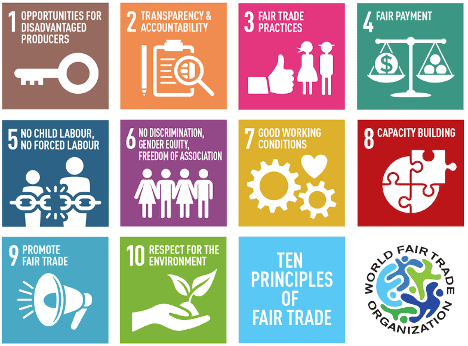
There is a Fair Trade certification that can be earned. In short, fair trade is an approach to trading where there is a partnership between producers + traders and businesses + consumers. The principles surrounding fair trade ensure that the people and the planet are put first.
Fair trade in its own right, however, is a model that can be followed even without the official certification process. And you can definitely find sustainable yarn suppliers that are committed to the principles surrounding fair trade (as seen in the colorful image above). The Global Organic Textile Standard (GOTS) certification which we talked about earlier, is more readily found in the yarn world (organic yarn) and has clear criteria around fair treatment of workers in order to earn their certification. This is probably the most black and white way of ensuring the yarn you’re buying was produced with respect for the workers who made it.
#5: RWS – Responsible Wool Standard
Wool is the most popular yarn made from animal fiber. Although wool is an amazing and sustainable fiber, there are important ethical considerations to be made when you choose what wool you will use. There are horrifying truths behind the way many of the sheep are treated on farms that are used for wool production. You can read more about those in a more detailed article I wrote about the challenges facing sustainable yarn here.
The RWS certification ensures responsible wool from sheep to store:
- Animal Welfare Protection: The Five Freedoms of animal welfare are protected with reference to standards and best practices around the world
- Land Health Preservation: Progressive methods of land management are practiced on RWS farms, protecting soil health, biodiversity, and native species.
- Social Welfare Protection: Social welfare, working conditions, and the health and safety of workers are addressed
- Chain of Custody: Certification makes sure the identity of the RWS wool is maintained from farm to final product.
- Credible Certification: A professional, third-party certification body audits each stage in the supply chain.
- Confident communication: Only products that meet all requirements may be labeled with the RWS logo
- Stakeholder engagement: The RWS is managed with the input of farmers, animal welfare experts, land conservation experts, brands, and retailers from all parts of the globe.
The RWS ensures that the wool comes from farms that prioritize animal welfare and adhere to sustainable land management practices. By choosing yarns with the RWS sustainable yarn certifications label, you support the global effort to ensure the humane treatment of animals and the conservation of natural resources.

Making Informed Choices
Making informed choices about the yarn we use is not just about personal preference or creative expression; it’s about taking responsibility for the impact our choices have on the environment. Understanding the environmental implications of different yarn fibers allows us to make conscious decisions that align with our commitment to sustainability.
With a clear understanding of the environmental impact of our yarn choices, we can take advantage of helpful sustainable yarn certification and how they can guide us towards more eco-friendly options. Yarn certification labels play a crucial role in helping us navigate the complex landscape of the yarn industry. They provide valuable information about the sourcing, production, and overall environmental and social impact of the yarn.
So next time you reach for a skein, take a moment to look beyond the vibrant colors and wonderful textures that draw us in. Pay attention to those tiny labels that hold immense value. They guide us towards genuine yarns, foster ethical production from farm to fiber, and empower us to make sustainable choices.
The labels may be small, but their impact is mighty.
“Education is for improving the lives of others and for leaving your community and world better than you found it.”
Marian Wright Edelman


Leave a Reply