
Learning how to count crochet rows and stitches is the key to keeping your project the correct size and your edges nice and straight. If your crochet swatch has gradually started turning into a triangle, trapezoid, or some other shape you definitely did not intend to make, your stitch count is probably changing from row to row.
In this lesson, you’ll learn how to identify and count single crochet stitches, count completed rows, and properly turn your work. We’ll also troubleshoot why crochet projects become narrower when stitches are skipped and wider when extra stitches are added—because your rectangle should remain a rectangle unless it has received very specific instructions otherwise.
LEARN TO crochet
Module 2: Core Crochet Stitches
Lesson 2: How to Count Crochet Rows & Stitches
This lesson is part of my free Learn to Crochet Course designed to take you from your very first stitch to completing your first projects and beyond.
24 step-by-step lessons with videos.
Materials You Will Need For This Lesson
- Worsted (4/Medium) Weight Yarn
- 5.5 mm Crochet Hook (a size 5.0 mm or 6.0 mm will work, if preferred)
- Scissors
- Yarn Needle
- Stitch Markers
A Little Help for Your Crochet Basket
Join and get the free Crochet Pro Essentials PDF Pack, plus gentle course reminders and new lessons in your inbox.
Why Counting Crochet Rows & Stitches Matters
Each row of a straight crochet project should usually contain the same number of stitches unless the pattern specifically tells you to increase or decrease.
If you begin with 15 single crochet stitches, your next row should contain 15 single crochet stitches. So should the row after that—and every following row until the pattern tells you otherwise.
Maintaining the correct stitch count helps your:
- Edges stay straight
- Rows remain the same width
- Project match the intended measurements
- Stitch pattern line up correctly
- Future self avoid having to unravel several rows while muttering things unsuitable for a beginner crochet course
Counting your stitches regularly allows you to catch a mistake soon after it happens. Fixing one row is much easier than discovering 12 rows later that your rectangle has been quietly pursuing a new career as a triangle.
Understanding the Anatomy of a Single Crochet Stitch
Before you can count your stitches, you need to know what you’re looking for.
When you look at the top edge of your crochet work, each single crochet stitch forms a small V. The two strands of that V are the front loop and back loop of the stitch.
Each complete V represents one stitch.
You can count stitches by looking at these V shapes across the top of the row. Begin with the first complete V and count each one until you reach the final stitch at the opposite edge.
The loop currently on your crochet hook does not count as a stitch. It is simply the working loop—the place where your next stitch will begin.

How to Count Crochet Stitches in Single Crochet
To count the single crochet stitches in your row:
- Place your work so you can clearly see the top edge.
- Find the first complete V at one end of the row.
- Count each V across the top of the fabric.
- Stop after the final complete V at the other edge.
- Do not count the working loop on your hook.
If you made 15 single crochet stitches, you should be able to count 15 V shapes across the top of your row.
Try gently stretching the top edge of your swatch if the stitches are difficult to see. This can help separate the V shapes and make each stitch easier to identify.
It is a good idea to count your stitches at the end of every row while you’re learning. Eventually, identifying the first and last stitches will become much more natural, and you may not need to count quite so obsessively. For now, though, counting is your friend.
How to Find the First Stitch of the Row
The first stitch can be confusing because the turning chain sits so close to it.
After you chain one and turn your work, look directly below the loop on your hook. The first actual stitch will have a complete V at the top. Insert your hook under both loops of that V to make your first single crochet.
Do not work into the turning chain from the previous row. That chain is located slightly off to the side of the row and does not count as one of your single crochet stitches.
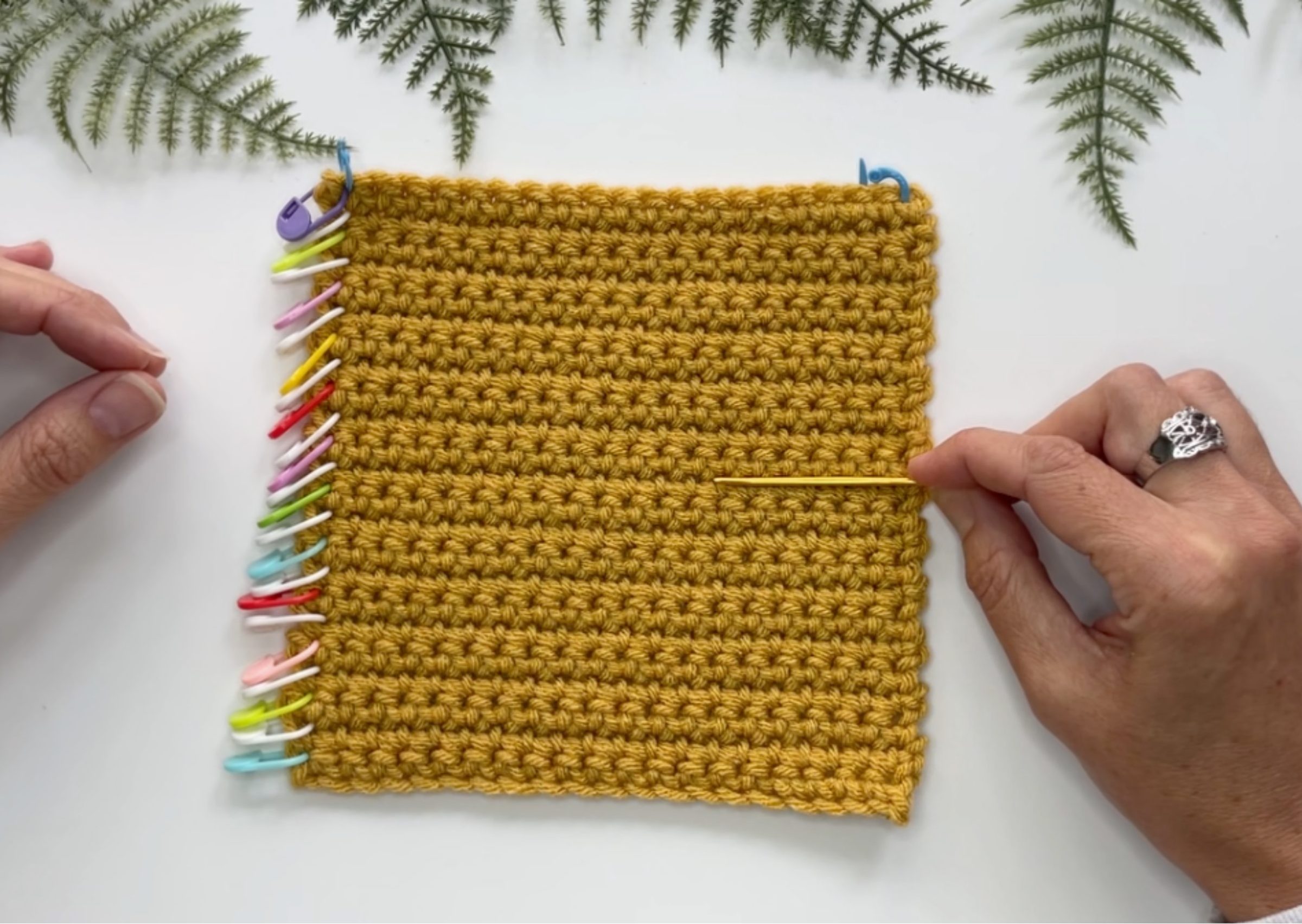
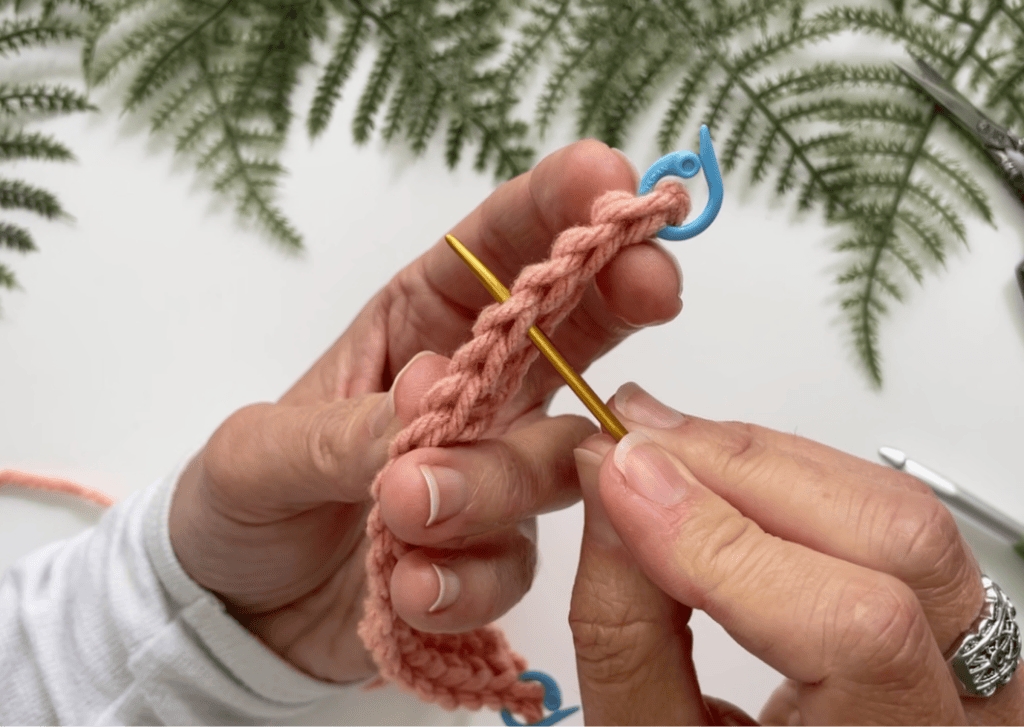
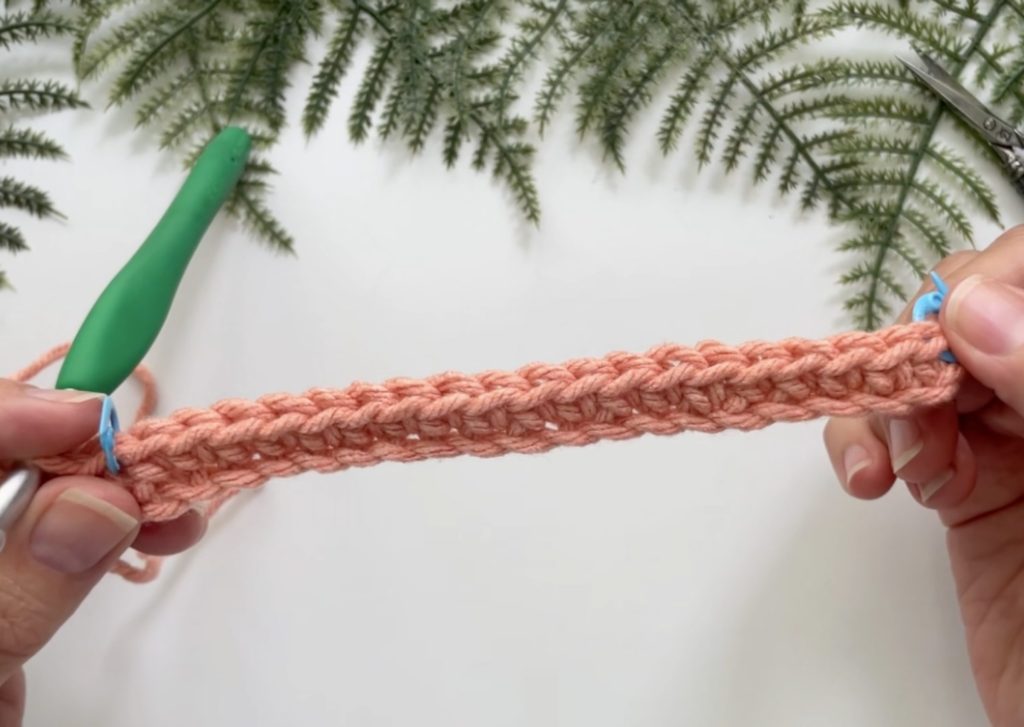
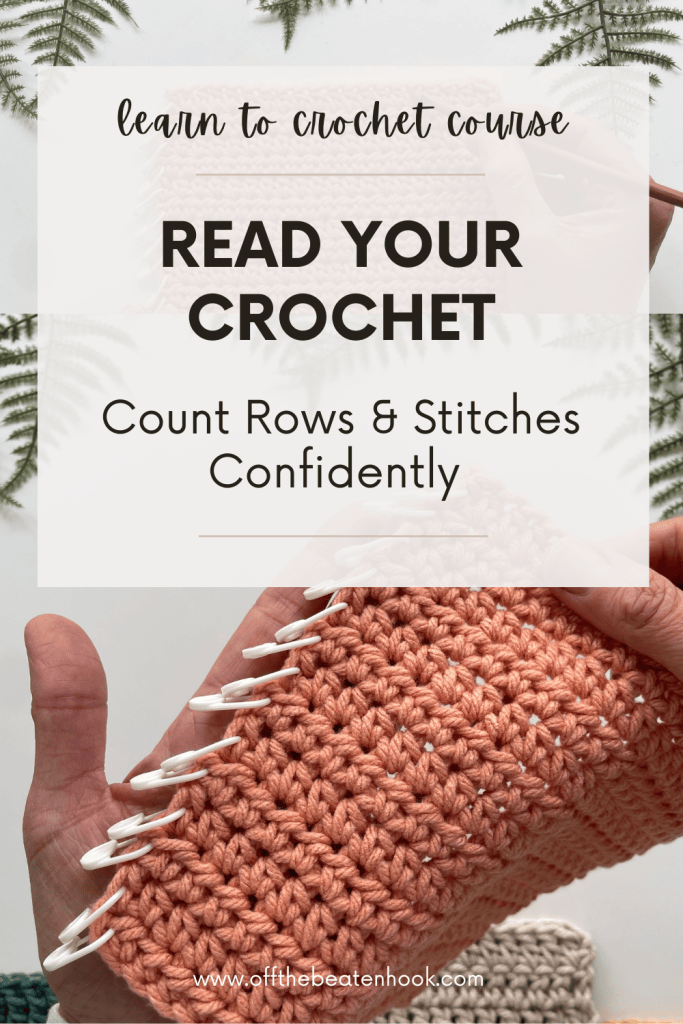
A stitch marker can make this much easier while you’re learning. Place a marker in the first single crochet as soon as you make it. When you return to that edge on the following row, the marker will show you exactly where the last stitch belongs.
How to Find the Last Stitch of the Row
The last stitch is often the trickiest one to recognize. It can pull downward or hide along the edge, making it look like you have finished the row before you actually have.
As you work across the row, look at the V shapes along the top. Your final single crochet should be worked into the last complete V.
If you placed a stitch marker in the first stitch of the previous row, that marked stitch will now be the last stitch you work into. Remove the marker, make the final single crochet, and then place the marker in the first stitch of your new row.
You can also stop when you have one or two stitches remaining and count backward from the beginning of the row. This is especially helpful if the edge stitches are difficult to see.
Stitch Markers Are Your Best Friend
Stitch markers are one of the simplest—and most helpful—tools you can use while learning how to count crochet rows and stitches. Think of them as tiny brightly colored reminders that say, “Yes, this really is a stitch. Please do not skip me later.”
The first and last stitches of a row can be difficult to recognize because they often lean, curl, or blend into the turning chain. Placing a stitch marker in these edge stitches removes much of the guesswork.
As soon as you make the first single crochet of a new row, place a stitch marker through the top of that stitch. When you work back across the following row, the marked stitch will be the final stitch you need to work into.
You can use stitch markers to help you:
- Identify the first and last stitches of each row
- Avoid accidentally skipping an edge stitch
- Prevent yourself from working into the turning chain
- Divide a longer row into smaller, easier-to-count sections
- Mark every fifth or tenth row
- Remember where you stopped if you put your project down
For a longer row, place a stitch marker every 10 or 20 stitches. Instead of repeatedly counting the entire row, you can count one smaller section at a time. Just make sure each marker is placed consistently—for example, after every tenth stitch—so your future self understands the system your past self created.
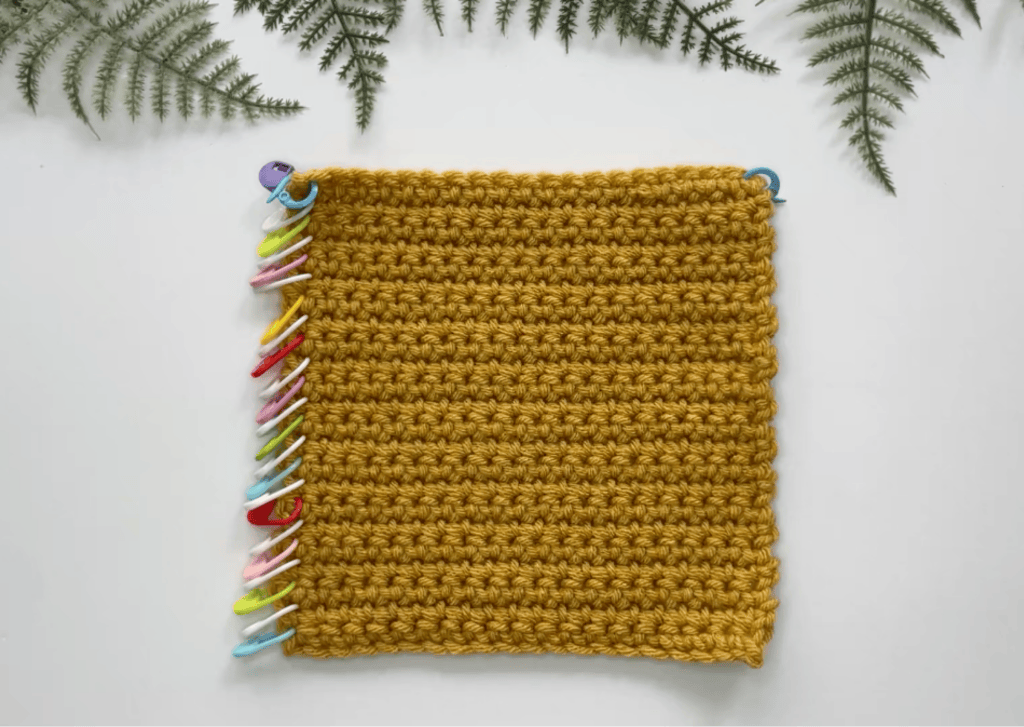
Stitch markers can also help you count rows. Place one in the first stitch of every fifth or tenth row, or move a single marker upward at regular intervals. This gives you a clear visual checkpoint and makes it much easier to determine how many rows you have completed.
To use a stitch marker at the edges of your single crochet swatch:
- Make the first single crochet of the row.
- Place a stitch marker through the top V of that stitch.
- Continue working across the row.
- When you reach the marker on the opposite edge, work into the marked stitch.
- Remove the marker.
- Chain one and turn.
- Make the first single crochet of the new row and place the marker into it again.
You will still want to practice recognizing and counting stitches without markers, but there is no need to make learning harder than it already is. Stitch markers are not a crutch—they are a useful tool, and crochet comes with enough counting opportunities without requiring you to rely entirely on memory. Even now years later, I’m pretty fanatical about using stitch markers – especially to help me mindlessly crochet without the worry of counting every single time. Ain’t no shame!
What to Do If Your Stitch Count Is Wrong
First, don’t panic. Miscounting stitches is an extremely normal part of learning to crochet.
If you have the wrong number of stitches:
- Count the row again to confirm the number.
- Check the first and last stitches.
- Look for a place where two stitches may have been worked into one.
- Look for an unworked V where a stitch may have been skipped.
- Unravel the row back to the mistake if necessary.
- Work the row again and recount before continuing.
Avoid correcting an accidental missing or extra stitch by casually adding or skipping another stitch in the following row. That may restore the number, but it will not fix the uneven edge or misplaced stitch below it.
It is usually better to go back and correct the original mistake—mildly irritating, yes, but far less irritating than finding it after you’ve completed half the project.
Watch the Video Lesson: How to Count Rows and Stitches
T
How to Count Crochet Rows
Once you know how many stitches are in each row, you may also need to determine how many rows you have completed.
When you work back and forth in single crochet, you turn your fabric at the end of each row. This means alternating rows face opposite directions.
To count single crochet rows, look at the front or side of your swatch and identify the horizontal ridges or stacked sections of stitches. Each trip across your work represents one completed row.
You can count rows in a few different ways.
Count the Horizontal Rows
Lay your swatch flat and begin at the foundation edge. Count each horizontal line of single crochet stitches as you move toward the working edge.
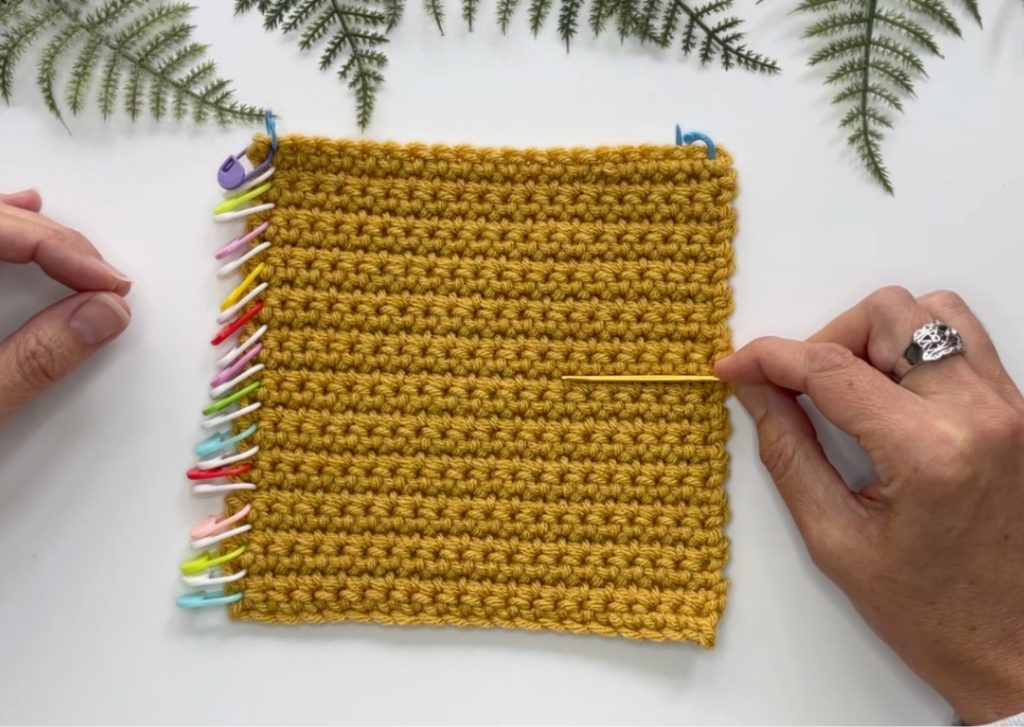
The foundation chain does not count as a row of single crochet. Your first row is the row of single crochet stitches worked into the foundation chain.
Count Along the Side Edge
You can also turn the swatch slightly and look at the side edge. Each row creates an edge stitch or small horizontal bar along the side.
Count these edge sections from the bottom of the swatch to the top. This method is particularly useful when the individual stitches blend together in the middle of the fabric.
Use a Row Counter or Tally
If you find it difficult to count completed rows visually, keep track as you crochet.
You can use:
- A mechanical or digital row counter
- A stitch-counting app
- Tally marks on a piece of paper
- A removable stitch marker placed every five or ten rows
There is no prize for keeping the entire row count in your head. Crochet already requires yarn, a hook, two hands, and a surprising amount of spatial reasoning. You are allowed to use notes.
Does the Foundation Chain Count as a Row?
No. Your foundation chain provides the base into which you work your first row, but it does not count as a row of single crochet.
If you make a foundation chain and then work single crochet stitches across it, you have completed one row of single crochet.
The turning chain at the beginning of each new row also does not create a separate row. It simply brings your hook to the appropriate height for the stitches you are about to make.

How to Properly Turn Your Work in Single Crochet
When you reach the end of a single crochet row, you need to create enough height for the next row before turning your work. This is done with a turning chain.
For single crochet, the turning chain is usually one chain.
Here is the basic process:
- Complete the final single crochet stitch of the row.
- Chain one.
- Turn your work so the opposite side is facing you.
- Locate the first actual stitch of the new row.
- Insert your hook under both loops of that stitch.
- Make your first single crochet.
Whether you chain before or after turning is largely a matter of preference unless your pattern gives specific instructions. I prefer to chain one and then turn because it keeps the process consistent and easy to remember.
The important part is knowing where to place the first single crochet after you turn.
Does the Turning Chain Count as a Stitch in Single Crochet?
In most single crochet patterns, the turning chain does not count as a stitch. (Personally, I’ve never seen it – but there’s a first time for everything!)
That means after chaining one and turning, work your first single crochet directly into the first stitch of the row.
The turning chain gives you the height needed to begin the new row, but it sits outside the stitch count.
For example, if your row contains 15 single crochet stitches:
- Chain one and turn.
- Do not count the chain as a stitch.
- Work one single crochet into each of the 15 stitches.
- Finish the new row with 15 stitches.
Always check the instructions in the pattern you are using. Designers may use slightly different methods, but the turning chain typically does not count as a stitch in single crochet.
A Note About Turning Chains in Other Crochet Stitches
The instructions in this lesson apply specifically to single crochet.
Half double crochet, double crochet, and treble crochet require taller turning chains. Whether those turning chains count as stitches can vary depending on the stitch, pattern, and method being used.
We’ll cover the turning process for each of those stitches in its own lesson. For now, focus on the single crochet rule:
Chain one, turn, and work into the first actual stitch. The turning chain does not count as a stitch.

How to Keep Your Crochet Edges Straight
Straight crochet edges become much easier once you consistently identify the first and last stitches. This is a critical part of learning accurately how to count crochet rows.
Use these beginner-friendly habits:
- Count your stitches after every row.
- Place a stitch marker in the first stitch of each row.
- Move the marker into the new first stitch every time you turn.
- Remember that the chain-one turning chain usually does not count as a stitch.
- Work the first single crochet into the first actual stitch.
- Make sure you work into the final complete V before turning.
- Pause and check your work every few rows.
If your pattern says you should have 15 stitches and you count 14 or 16, stop there. Finding the mistake now will save you from having to unravel more work later.
Why Is My Crochet Getting Narrower?
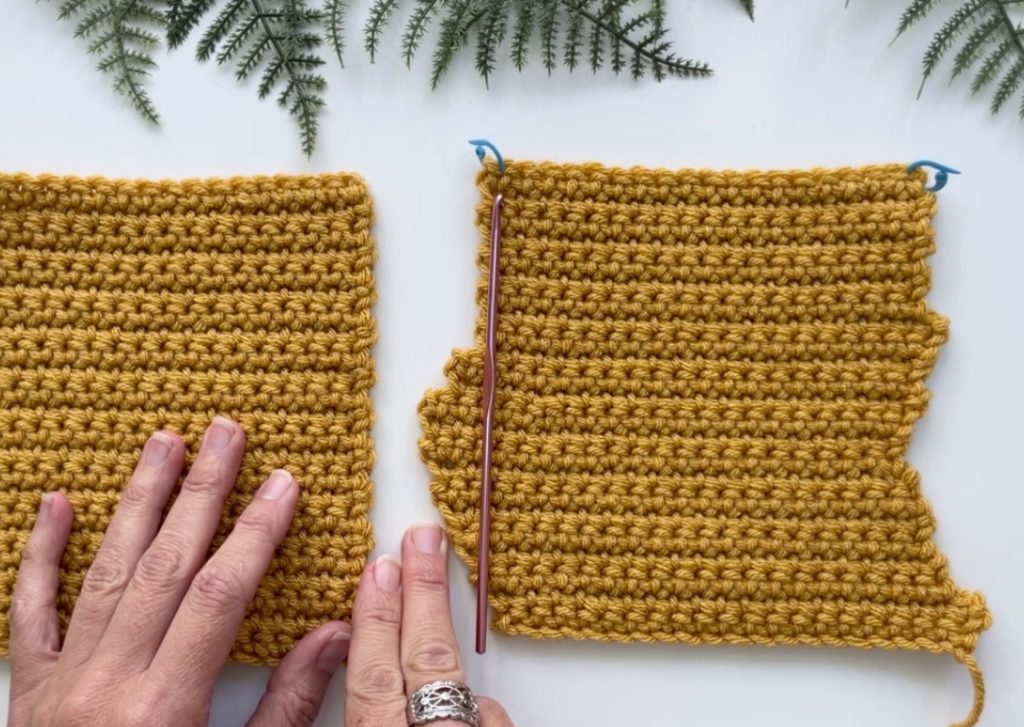
If your crochet project is becoming narrower with every row, you are accidentally decreasing the number of stitches.
This usually happens because you are:
- Skipping the first stitch after turning
- Missing the last stitch at the end of the row
- Mistaking the final stitch for part of the turning chain
- Losing track of your stitch count
Skipping one stitch may not look dramatic at first. But if you lose one stitch in several consecutive rows, the sides of your project will quickly begin slanting inward.
For example:
- Row 1: 15 stitches
- Row 2: 14 stitches
- Row 3: 13 stitches
- Row 4: 12 stitches
Your project is not mysteriously shrinking. It is simply losing stitches, one row at a time.
To correct the problem, count every row and use stitch markers to identify the first and last stitches.
Why Is My Crochet Getting Wider?
If your crochet project is becoming wider, you are accidentally adding stitches.
This commonly happens when you:
- Work into the turning chain at the end of the row
- Mistake the side of the previous row for another stitch
- Accidentally place two single crochets in one stitch
For example:
- Row 1: 15 stitches
- Row 2: 16 stitches
- Row 3: 17 stitches
- Row 4: 18 stitches
This causes the sides of the fabric to slant outward.
Again, your stitch count provides the quickest answer. If the row contains more stitches than it should, look closely at the beginning and end of the row to see where an extra stitch may have sneaked in.
FAQs
You are most likely skipping the first stitch after turning or missing the final stitch at the end of the row. Marking the first stitch and counting every row can help you find both edges.
You may be working into the turning chain at the end of the row or placing two stitches into the same stitch. In single crochet, the chain-one turning chain usually does not count as a stitch.
No. The working loop on your hook does not count as a stitch. When counting, only count the complete V shapes across the top of your crochet fabric.
Usually, no. The chain one provides the height needed to begin the new row, but it does not count as a single crochet stitch unless your pattern specifically says otherwise.
Yes. When the chain-one turning chain does not count as a stitch, work your first single crochet into the first actual stitch of the row.
No. The foundation chain is the base of your work. The stitches worked into that chain create your first row.
Your tension may be changing, or your turning chains and edge stitches may be looser than the stitches in the center. Minor unevenness is normal and may improve with practice or blocking.
How to Count Crochet Rows & Stitches Practice Challenge
Make a small single crochet swatch to practice counting and turning:
- Chain 21.
- Work one single crochet into the second chain from the hook and into each remaining chain.
- Count your stitches. You should have 20 single crochet stitches.
- Chain one and turn.
- Work one single crochet into the first stitch and each stitch across.
- Count the row again to confirm that you still have 20 stitches.
- Repeat until you have completed ten rows.
- Count the rows and check that both side edges remain straight.
Place a stitch marker in the first stitch of each row if you need help identifying the edges.
If your finished swatch has 20 stitches in every row, ten rows total, and reasonably straight sides, you’ve got it. “Reasonably” is included because handmade fabric is allowed to have a personality.

You Can Count Your Stitches and Rows!
You’ve learned how to count crochet rows and stitches, recognize the first and last stitches, turn your work correctly, and keep your edges straight. These skills may not feel quite as exciting as learning a brand-new stitch, but they’re what keep your rectangles from quietly becoming trapezoids—and that is a milestone worth celebrating.
Next, we’ll learn how to half double crochet. This stitch is taller than single crochet, works up a little faster, and introduces one new step: the yarn over. Grab your hook and practice yarn—we’re officially expanding your crochet stitch repertoire!
← Previous Lesson: How to Single Crochet
SOCIAL MEDIA YOUR THING?
Connect with me on your favorite social network!
Pin This Lesson for Later
Leave a Reply