

Trying to figure out how big to make a crochet blanket? You’ve landed in the right place. Whether you’re making a tiny lovey, a couch throw, or a blanket for a queen-size bed, this crochet blanket sizes chart gives you a dependable place to start. Plus, you’ll find a quick, free printable guide to every blanket size (in inches an cm!) plus how much yarn to plan for your project.
There isn’t one official size for every handmade blanket. A few extra inches usually won’t spoil a cozy throw, and bed blankets can be made with more or less drape depending on how you like them to look. Use the measurements below as practical guides, then adjust for the person, bed, yarn, and stitch pattern.
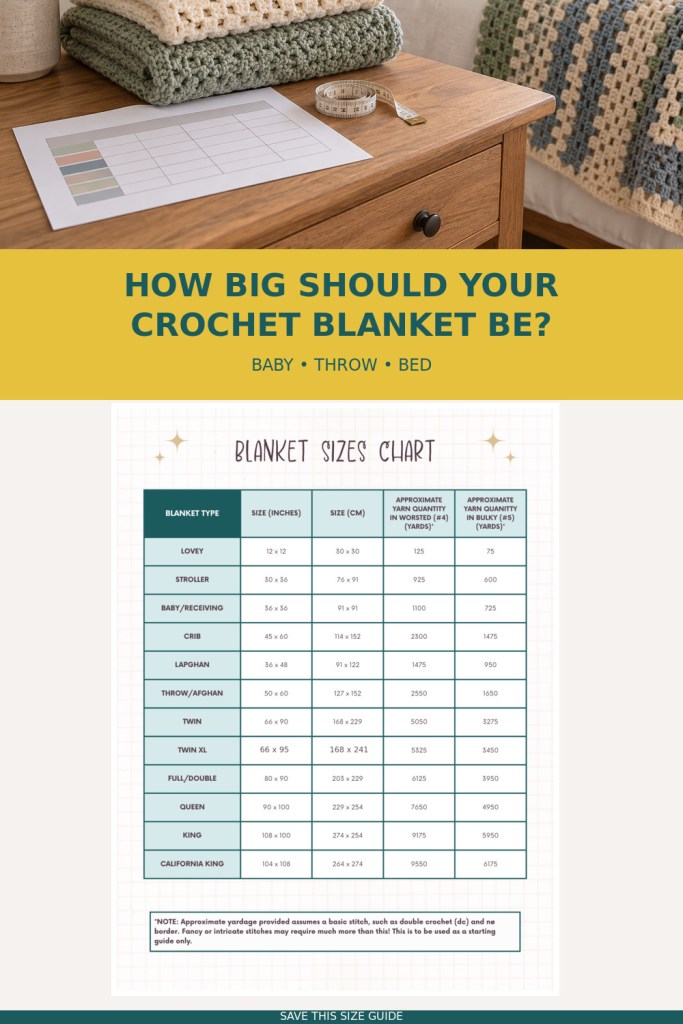
Jump into the crochet blanket sizes guide now, or PIN it for later here!

LOVE COLLECTING Patterns?
If you love collecting crochet patterns, you might enjoy my Fiber Love Club — it gives you lifetime access to every pattern I’ve ever designed (plus all future releases).
Instead of buying patterns one by one, unlock the full pattern vault forever in one simple payment.
Crochet Blanket Sizes Chart
The measurements below are finished blanket dimensions, listed as width × length. Centimeters are rounded to the nearest whole centimeter.
| Blanket type | Suggested finished size (inches) | Approx. size (cm) | A good choice for |
|---|---|---|---|
| Lovey | 12 × 12 in | 30 × 30 cm | A small comfort or keepsake blanket |
| Stroller | 30 × 36 in | 76 × 91 cm | Outings and supervised use |
| Baby / receiving | 36 × 36 in | 91 × 91 cm | A versatile square baby blanket |
| Crib | 45 × 60 in | 114 × 152 cm | A larger blanket for supervised use or older children |
| Lapghan | 36 × 48 in | 91 × 122 cm | A lap blanket for a chair, recliner, or wheelchair |
| Throw | 50 × 60 in | 127 × 152 cm | A couch, chair, or decorative bed throw |
| Twin | 66 × 90 in | 168 × 229 cm | A standard twin bed |
| Twin XL | 66 × 95 in | 168 × 241 cm | A longer twin bed |
| Full / double | 80 × 90 in | 203 × 229 cm | A full or double bed with some side drape |
| Queen | 90 × 100 in | 229 × 254 cm | A queen bed with comfortable coverage |
| King | 108 × 100 in | 274 × 254 cm | A standard king bed with side drape |
| California king | 104 × 108 in | 264 × 274 cm | A longer, narrower California king bed |
These are suggested handmade crochet blanket sizes, not strict standards. Especially for baby blankets, lap blankets, and throws, you can make the dimensions suit the recipient and the way the blanket will be used. For a bed blanket, measure the mattress and decide how far you want the blanket to hang over each side before choosing your finished size.

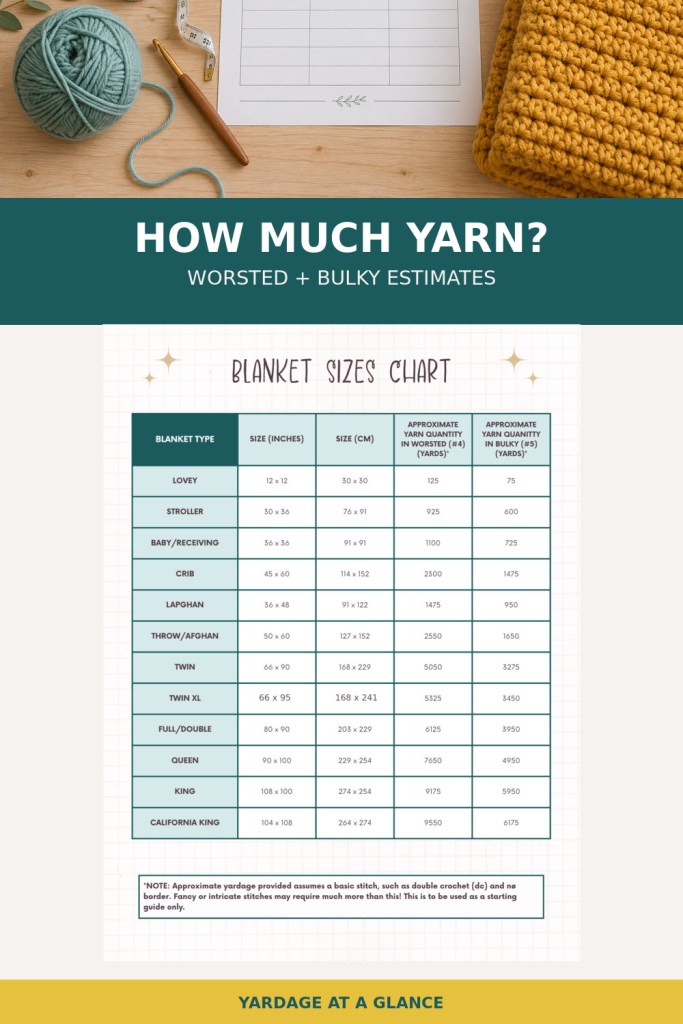
Click here to download the above chart. These are approximate estimates, not pattern yardage guarantees. The same yarn weight can vary in thickness, and your hook and tension affect how much yarn each square inch of fabric uses. A denser stitch or a large border will take more yarn; an open stitch may take less. If a pattern provides yardage for your size, use that estimate first. Otherwise, consider buying about 10–15% extra, ideally from the same dye lot.
How to Estimate Blanket Yardage From a Swatch
For a closer estimate, make a swatch with the exact yarn, hook, and stitch you plan to use. A kitchen scale lets you scale the yarn amount to your intended blanket size:
- Crochet a square swatch, ideally about 6 × 6 inches, and weigh it in grams.
- Multiply the swatch’s width by its length to get its area. A 6 × 6-inch swatch covers 36 square inches.
- Divide the planned blanket area by the swatch area, then multiply by the swatch’s weight. That estimates the total grams of yarn.
- Convert grams to yards using the yardage and weight listed on the yarn label, then add extra for edging or fringe.
For example, if a 36-square-inch swatch weighs 18 grams and your blanket is 3,000 square inches, the blanket will take about 1,500 grams before edging: 3,000 ÷ 36 × 18. If the yarn label gives 200 yards per 100 grams, that works out to roughly 3,000 yards. Your real total may shift a little as your tension changes, so treat the swatch calculation as an estimate too.
Converting Yardage into Skeins
Once you know how many yards you’ll need for the blanket you’re making, it’s a quick calculation to figure out how many skeins/balls of yarn you’ll need. You will need the amount of yarn per skein/ball which will be listed on the label of the yarn you’re using.
Here is the formula:
YARDS NEEDED ÷ YARDS PER SKEIN = SKEINS REQUIRED
Example:
- Blanket requires: 2,000 yards
- Yarn ball contains: 196 yards per skein
2,000 ÷ 196 = 10.2 skeins
You’ll want to round UP and buy 11 skeins for your blanket.
Baby Crochet Blanket Sizes
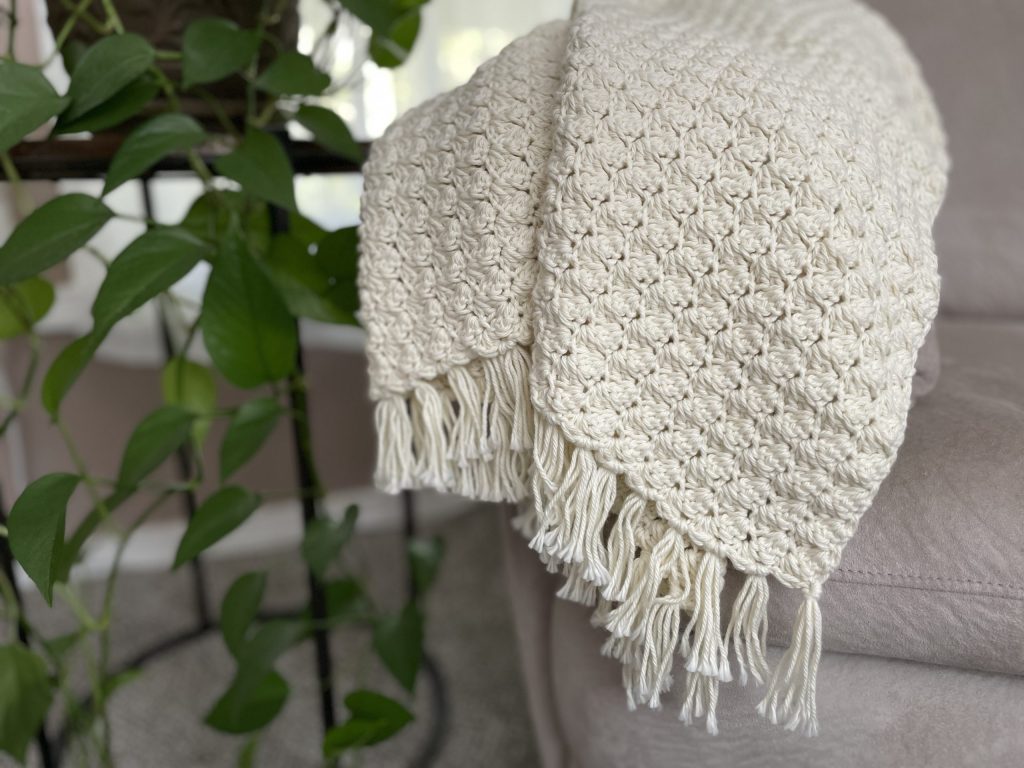
Baby blankets come in several useful sizes, from small loveys to larger blankets for floor time or a stroller. A 36 × 36-inch square is a flexible all-purpose size for a handmade baby blanket. A 30 × 36-inch blanket is a handy smaller option for outings, while a 45 × 60-inch blanket gives more room for supervised play or use as a keepsake.
If you’re making a baby blanket as a gift, think about where it will be used and how easy it will be to wash. A smaller blanket is easier to carry; a larger one will be useful for longer as the child grows. Check the pattern’s finished dimensions, since labels like “baby blanket” can mean different sizes from one pattern to another.
Safe-sleep note: The American Academy of Pediatrics advises keeping loose blankets and other soft objects out of an infant’s sleep space. A handmade blanket is best used for supervised activities, such as stroller outings or playtime, and should not be placed in a crib or bassinet for an infant to sleep with. Follow current safe-sleep guidance for the child’s age.
Lapghan and Throw Blanket Sizes
A lapghan is sized to cover someone’s lap while they’re sitting, without creating a lot of extra fabric to manage. Around 36 × 48 inches is a useful starting point for a chair or wheelchair blanket. If you’re making one for a particular person, measure from their lap toward their feet while seated and adjust the length to suit them.
A throw blanket is usually larger than a lapghan. Around 50 × 60 inches is a familiar couch-throw size: enough to cover your legs or wrap around your shoulders, without the commitment of crocheting something the size of a small bedroom. If you want more full-body coverage, try a wider or longer throw, such as 60 × 70 inches.
The terms throw and afghan are sometimes used interchangeably. When a pattern calls a project an afghan, check the actual measurements rather than assuming it means one particular size.
Bed Blanket Sizes
Bed blanket sizes are larger than mattress sizes because the blanket may need to hang over the sides and foot of the bed. The chart uses common blanket dimensions as a starting point, with some extra width and length for drape.
| Bed size | Approx. mattress size (inches) | Suggested blanket size (inches) |
|---|---|---|
| Twin | 38 × 75 in | 66 × 90 in |
| Twin XL | 38 × 80 in | 66 × 95 in |
| Full / double | 54 × 75 in | 80 × 90 in |
| Queen | 60 × 80 in | 90 × 100 in |
| King | 76 × 80 in | 108 × 100 in |
| California king | 72 × 84 in | 104 × 108 in |
Mattress dimensions are common U.S. sizes; the blanket measurements are practical crochet suggestions. Mattress thickness, bed frame height, whether you want the blanket to cover pillows, and whether you tuck it in all affect the size you’ll want. If you prefer a shorter topper with little overhang, make the blanket closer to the mattress dimensions. For more drape, add to the width and length.
How to Choose the Right Bed Blanket Drape
Before you start, measure the mattress and decide how far you want the blanket to drop on the sides. For example, if your queen mattress is 60 inches wide and you want about 12 inches of overhang on each side, plan for roughly 84 inches of width before adding any extra for a generous look. Your bed’s height and your preferred style will affect the final measurement.
If you want the blanket to cover pillows, add extra length at the head. If you plan to tuck it in at the foot, allow more length there, too. A blanket intended as a decorative layer may not need as much coverage as one you’ll use every night.
How to Choose the Right Crochet Blanket Size
Start with the blanket’s job. A stroller blanket needs to be portable; a lapghan should cover someone comfortably while seated; a couch throw can be as small or oversized as you like. For a bed, start with the mattress measurements and add the drape you want.
Then think about the yarn and stitch pattern. A dense stitch can make a warm, weighty blanket, while an open stitch creates a lighter fabric. Bulkier yarn and a larger hook may make a project grow faster, but they also affect the blanket’s drape and total weight. If you’re following a pattern, use its finished measurements as your starting point.
Remember to include the border in the final size. A border worked around all four sides can add several inches to both the width and length. If you have a specific finished measurement in mind, make the center a little smaller and measure again after the border.
How to Calculate the Starting Chain for a Crochet Blanket
There isn’t one universal starting-chain number for a given blanket size. The number depends on your yarn, hook, tension, stitch pattern, and the pattern’s stitch multiple. A quick gauge swatch gives you a much better estimate than borrowing someone else’s chain count.
- Crochet a small swatch in the stitch pattern you plan to use.
- Measure how many stitches fit across one inch. If your swatch has 20 stitches across 5 inches, your gauge is 4 stitches per inch.
- Multiply your desired blanket width by your stitches per inch.
- Adjust the result to fit the pattern’s stitch multiple, turning-chain instructions, or edge stitches.
Example: You want a 50-inch-wide throw and your swatch measures 4 stitches per inch. Multiply 50 by 4 to get about 200 stitches across. If the stitch pattern uses a multiple of 6 plus 2, adjust the count to the nearest number that follows that rule. Check the pattern’s instructions before chaining, because the turning chain may or may not count as a stitch.
This estimate works best for blankets crocheted in rows from one edge to the other. For granny squares, C2C, or other constructions, use the finished size of a motif, square, or block to plan how many you’ll need.
How to Make a Crochet Blanket Bigger or Smaller
Most blanket patterns can be adjusted, but the best approach depends on how the blanket is constructed.
- For a blanket worked in rows: Add or subtract stitches to change the width, following the stitch multiple. Add or remove rows to change the length.
- For a granny-square blanket: Make more or fewer squares, or use a different number of rounds per square. Check how the border changes the finished dimensions.
- For a C2C blanket: Add or remove diagonal rows to change the dimensions. For a rectangle, follow the pattern’s increase and decrease instructions so the proportions stay on track.
- For a blanket with a border: Include the border in your final measurement. A wide or textured border can noticeably change the size.
If you’re changing a pattern’s size, consider how much extra yarn you’ll need. A larger blanket can take much more yarn than it seems, especially with dense stitches or a wide border. Buy enough yarn from the same dye lot when possible, and keep a note of the finished dimensions and any changes you made.
Crochet Blanket Sizes Guide FAQs
There isn’t one universal standard. A throw is often around 50 × 60 inches, a lapghan around 36 × 48 inches, and a twin bed blanket around 66 × 90 inches. Use the chart above as a guide and adjust the measurements to fit your project.
A versatile square baby blanket is about 36 × 36 inches. A smaller stroller blanket may be around 30 × 36 inches, while a larger crib-style blanket may be about 45 × 60 inches. Choose based on how it will be used, and follow current safe-sleep guidance for infants.
A common throw size is about 50 × 60 inches. You can make it smaller for a chair or larger if you want more coverage on the couch.
A useful starting point is about 90 × 100 inches. Measure your mattress and decide how much side and foot drape you want, since mattress height and personal preference can change the ideal dimensions.
The chart lists the finished size, including any border. If you’re following a pattern that lists the main blanket measurements before edging, remember the border will make the finished project larger.
It depends on your stitch gauge and pattern. Multiply the blanket’s desired width in inches by the number of stitches per inch in your swatch, then adjust for the stitch multiple and edge stitches in your pattern.
Yes. Handmade blanket dimensions are flexible. Choose a size that suits the person and purpose, and use a gauge swatch and stitch multiple to help you reach the measurements you want.

Final Thoughts
The best crochet blanket size is the one that works for the person who’ll use it. Use the chart to get started, measure your swatch, and adjust for the border and the amount of drape you want. A few inches either way is part of the handmade charm—and possibly part of the reason no two blankets are exactly alike.
If you’re looking for a blanket project to start today, browse my free blanket patterns for your next project!
Pin this Crochet Blanket Sizes Guide here:
Leave a Reply