
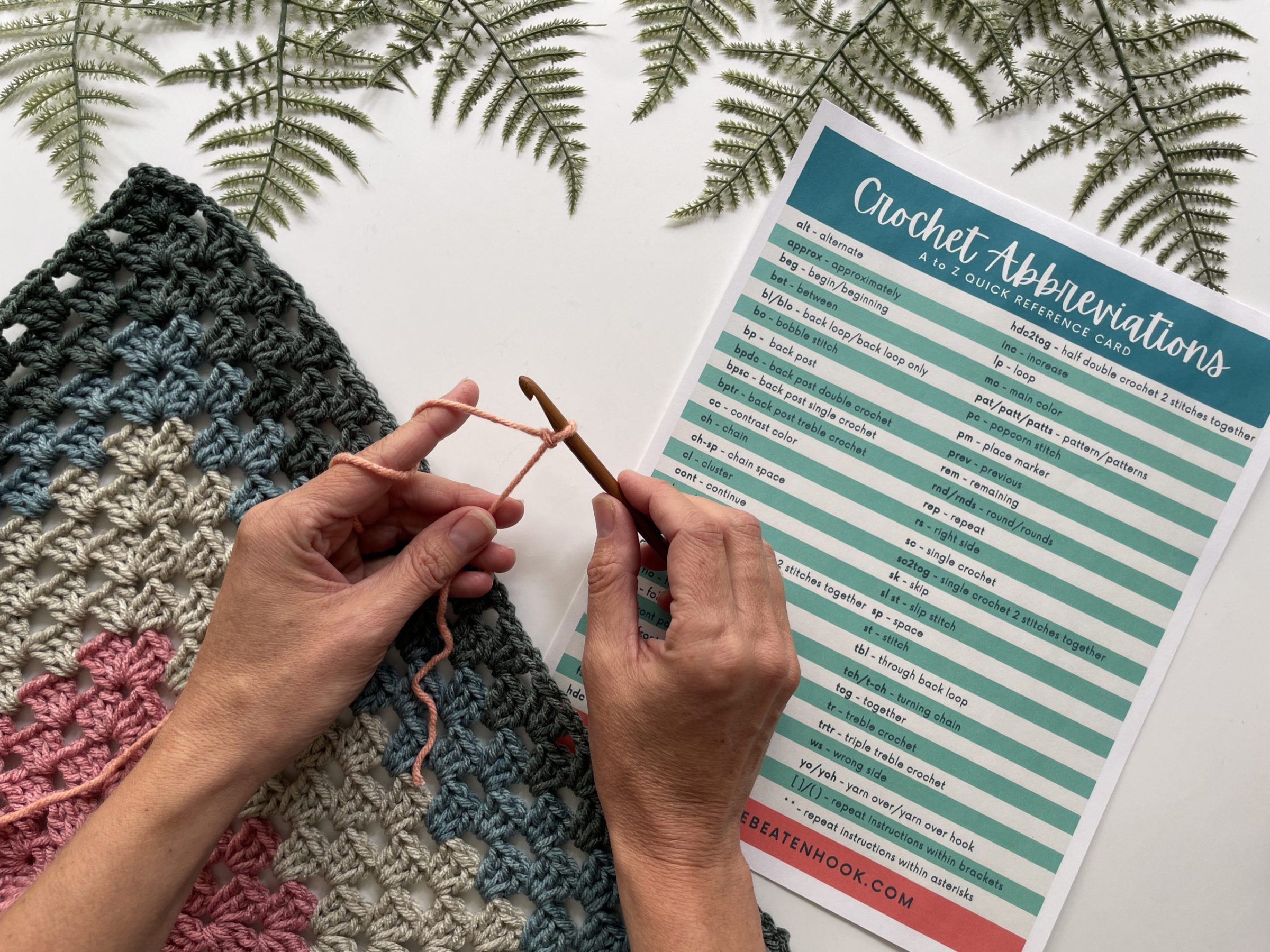
Crochet abbreviations are the shortened terms used to describe stitches, techniques, and instructions in written crochet patterns. At first, they can make a perfectly innocent pattern look like someone spilled a bowl of alphabet soup—but once you understand the most common abbreviations, everything begins to make much more sense.
In this lesson, you’ll learn what crochet abbreviations mean, why designers use them, and how to recognize the shorthand you’ll see most often in patterns. We’ll also cover the difference between US and UK crochet terms, along with a few symbols and phrases that help organize pattern instructions.
LEARN TO crochet
Module 3: From Stitches to Projects
Lesson 1: Crochet Abbreviations
This lesson is part of my free Learn to Crochet Course designed to take you from your very first stitch to completing your first projects and beyond.
24 step-by-step lessons with videos.

A Little Help for Your Crochet Basket
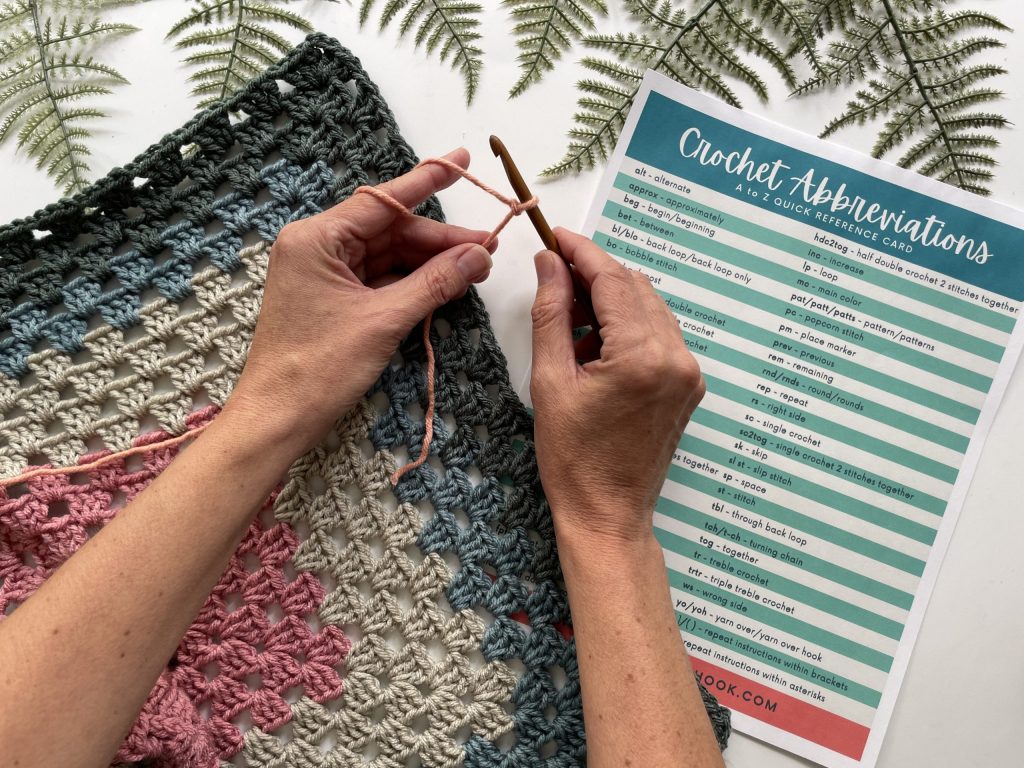
Join and get the free Crochet Pro Essentials PDF Pack, plus gentle course reminders and new lessons in your inbox. This PDF pack includes a downloadable crochet abbreviations quick reference guide that will come in so handy as you learn to crochet!
What Are Crochet Abbreviations?
Crochet abbreviations are shortened versions of frequently used crochet words and instructions. For example, instead of writing “double crochet” every time the stitch appears, a pattern will use the abbreviation “dc.”
Imagine a pattern that instructed you to “double crochet in each stitch across” for twenty rows. Writing out every word would make the pattern unnecessarily long and harder to scan. Using abbreviations keeps instructions shorter, cleaner, and easier to follow once you know what they mean.
Most patterns include a list of the abbreviations used somewhere near the beginning. However, many common abbreviations are considered standard and appear in patterns again and again. Learning those now will make reading patterns much less intimidating later.
Why Do Crochet Patterns Use Abbreviations?
Crochet patterns use abbreviations because crochet instructions tend to repeat the same words—a lot. There are only so many times a designer can type “half double crochet” before everyone agrees that “hdc” will do just fine.
Abbreviations help:
- Keep written patterns concise
- Make instructions easier to scan
- Prevent long sentences from becoming overwhelming
- Create a more consistent pattern format
- Save space in printed patterns
They may feel like an entirely new language in the beginning, but you don’t need to memorize every abbreviation before using a pattern. Even experienced crocheters occasionally look one up.
Common Crochet Stitch Abbreviations
Let’s begin with the crochet abbreviations you’re most likely to encounter as a beginner. These are written using standard US crochet terminology.
| Abbreviation | Meaning |
|---|---|
| ch | chain |
| sl st | slip stitch |
| sc | single crochet |
| hdc | half double crochet |
| dc | double crochet |
| tr | treble crochet |
| st | stitch |
| sts | stitches |
You’ve already learned each of the primary stitches in this list during Module 2. The only difference now is that we’re replacing the full stitch names with their abbreviated versions.
For example:
Full instruction: Double crochet in each stitch across.
Abbreviated instruction: Dc in each st across.
Both instructions tell you to do exactly the same thing. The second one simply takes up less space and looks more like the instructions you’ll find in a typical crochet pattern.
Watch the Crochet Abbreviations Video Lesson
If you’re looking for an abbreviation you don’t see on my chart, the Craft Yarn Council has an awesome, robust resource of crochet abbreviations as well! You can find that right here.
Common Crochet Instruction Abbreviations
In addition to stitch names, patterns abbreviate many of the words used to explain where and how to work your stitches.
| Abbreviation | Meaning |
|---|---|
| beg | beginning |
| ch-sp | chain space |
| ea | each |
| foll | following |
| lp | loop |
| rem | remaining |
| rep | repeat |
| rnd | round |
| rnds | rounds |
| RS | right side |
| sk | skip |
| sp | space |
| tog | together |
| WS | wrong side |
| yo | yarn over |
You may also see some abbreviations written with or without spaces or punctuation. For example, “chain space” may appear as ch-sp, ch sp, or occasionally chsp. The meaning is the same.
Crochet Shaping Abbreviations
As you begin making projects with more shaping, you’ll also encounter abbreviations that tell you to increase or decrease the number of stitches.
| Abbreviation | Meaning |
|---|---|
| inc | increase |
| dec | decrease |
| sc2tog | single crochet two together |
| hdc2tog | half double crochet two together |
| dc2tog | double crochet two together |
An increase generally means working more than one stitch into the same stitch or space. A decrease combines two or more stitches so they become one stitch.
Don’t worry if you haven’t practiced all of these techniques yet. We’ll cover increases and decreases step by step later in the course. For now, the goal is simply to recognize what the abbreviations refer to when you see them.
Front Loop and Back Loop Abbreviations
Unless a pattern tells you otherwise, you will usually insert your hook beneath both loops at the top of a stitch. Sometimes, however, a pattern will direct you to work into only one of those loops.
| Abbreviation | Meaning |
|---|---|
| FLO | front loop only |
| BLO | back loop only |
Working through only the front or back loop changes the appearance and texture of the fabric. We’ll explore these techniques more closely in Module 4 when we learn about stitch texture, ribbing, and working into different loops.
For now, remember that FLO means to work into the front loop only, while BLO means to work into the back loop only.
Understanding US and UK Crochet Terms
Before beginning a crochet pattern, check whether it uses US or UK crochet terminology. The same abbreviation can refer to different stitches depending on which terminology the designer uses—and that is a fairly important detail unless you enjoy unexpectedly creating something twice the intended size.
The patterns and lessons throughout this course use US crochet terminology.
Here are some of the most common differences:
| US Term | US Abbreviation | UK Term | UK Abbreviation |
|---|---|---|---|
| slip stitch | sl st | slip stitch | sl st |
| single crochet | sc | double crochet | dc |
| half double crochet | hdc | half treble crochet | htr |
| double crochet | dc | treble crochet | tr |
| treble crochet | tr | double treble crochet | dtr |
Notice that there is no UK stitch called a single crochet. A US single crochet is called a double crochet in UK terminology.
Most designers will clearly state which terminology they use near the beginning of the pattern. If the pattern doesn’t specify, look for clues in the stitch list. If it includes “single crochet,” it is almost certainly written using US terms.
Capitalization and Punctuation in Crochet Patterns
Crochet abbreviations are generally written in lowercase letters, although abbreviations such as RS, WS, FLO, and BLO are often capitalized. You may also notice that some designers use periods after abbreviations while others do not.
For example, you might see:
- dc
- dc.
- DC
These all mean the same thing. Crochet pattern formatting can vary slightly between designers, but a well-written pattern should remain consistent throughout the instructions.
A period typically ends an instruction, while a comma separates steps that are completed in sequence.
For example:
Ch 1, turn. Sc in each st across.
This means:
- Make one chain.
- Turn your work.
- Work one single crochet into each stitch across the row.
Read each comma or period as a small pause between actions. It helps prevent the instructions from turning into one long blur of yarn-related commands.
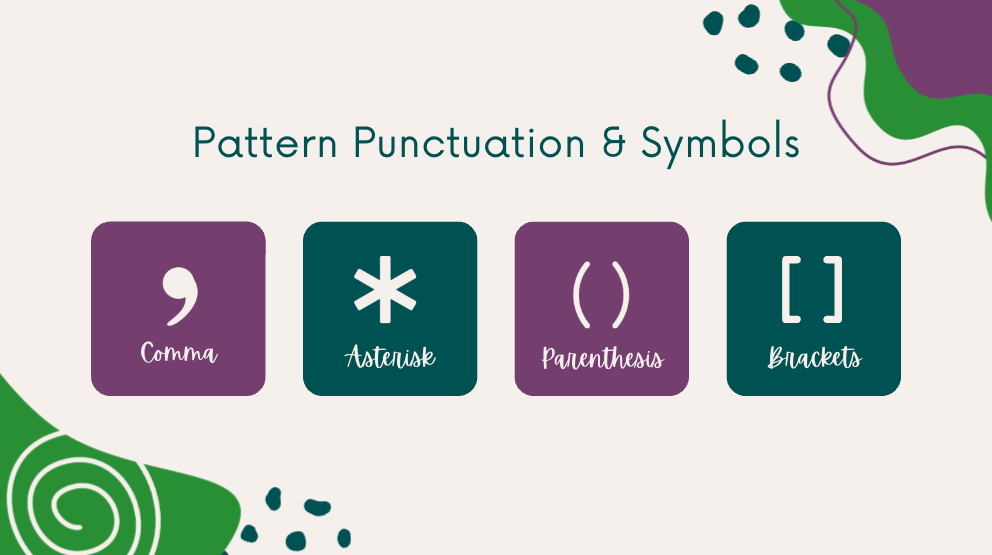
What Do Asterisks, Parentheses, and Brackets Mean?
Written crochet patterns also use punctuation marks to group instructions or show which steps should be repeated. The exact formatting can vary, so always check the pattern notes for clarification.
Asterisks
An asterisk usually marks the beginning of a repeated sequence.
For example:
*Sc in next st, dc in next st; rep from * across.
This means you will:
- Single crochet in the next stitch.
- Double crochet in the following stitch.
- Repeat those two instructions across the row.
Parentheses
Parentheses may group stitches that should all be worked into the same stitch or space.
For example:
(Sc, ch 2, sc) in next ch-sp.
This means you will work one single crochet, chain two, and another single crochet—all into the next chain space.
Parentheses may also show the stitch count at the end of a row or round:
(20 sts)
This tells you that you should have 20 stitches when that row or round is complete. Think of it as the pattern quietly asking you to check your work before things get out of hand.
Brackets
Brackets are often used to group a longer set of instructions, especially when the grouped section contains parentheses of its own.
For example:
[Sc in next st, (dc, ch 1, dc) in next st] 4 times.
Complete everything inside the brackets four times.
We’ll take a much closer look at how these symbols work together in the next lesson when we learn how to read a written crochet pattern from beginning to end.
How to Read a Line of Crochet Abbreviations
Let’s translate a simple line of abbreviated crochet instructions:
Row 1: Ch 21. Sc in 2nd ch from hook and in ea ch across. Turn. (20 sts)
Written out in full, this means:
Row 1: Make 21 chains. Work one single crochet into the second chain from the hook, then work one single crochet into each remaining chain across. Turn your work. You should have 20 stitches.
Here’s another example:
Row 2: Ch 1. Hdc in ea st across. Turn. (20 sts)
Written out in full, this means:
Row 2: Make one turning chain. Work one half double crochet into each stitch across the row. Turn your work. You should still have 20 stitches.
When you first begin reading patterns, it’s completely fine to translate the instructions one abbreviation at a time. With practice, you’ll begin recognizing the abbreviations automatically—just as you recognize common words without sounding out every letter.

Tips for Learning Crochet Abbreviations
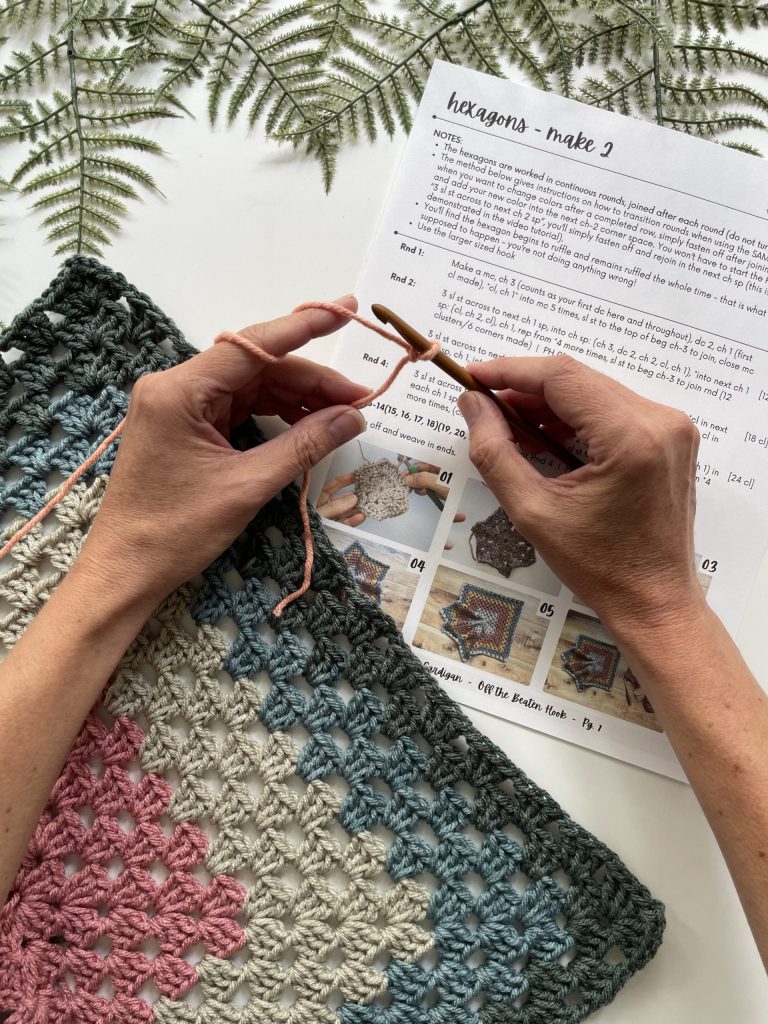
You do not need to sit down and memorize an entire crochet abbreviation chart before trying your first written pattern. You’ll learn much faster by seeing the abbreviations used in real instructions.
Here are a few ways to make the process easier:
- Keep an abbreviation chart nearby while you crochet.
- Check the abbreviation list included with each new pattern.
- Confirm whether the pattern uses US or UK terminology.
- Read through the entire pattern before beginning.
- Circle or highlight unfamiliar abbreviations.
- Translate complicated instructions into full words if necessary.
- Practice with a simple pattern that uses stitches you already know.
The most common abbreviations—such as ch, sc, hdc, dc, and st—will quickly become familiar because you’ll see them so often. The less common ones can be looked up whenever you need them. There is no final exam conducted by the crochet abbreviation authorities.

Keep This Crochet Abbreviation Chart Handy
Crochet abbreviations are meant to make patterns easier to read, not more confusing. Once you understand that each abbreviation is simply a shortened stitch or instruction, written patterns begin to feel far more approachable.
Access the resource library and save or print the crochet abbreviation chart included with this lesson and keep it nearby as you work through your first few patterns. Before long, instructions like “ch 1, turn, sc in ea st across” will look completely normal—which is a sentence only crocheters can fully appreciate.
FAQs
Some of the most common crochet abbreviations are ch for chain, sl st for slip stitch, sc for single crochet, hdc for half double crochet, dc for double crochet, tr for treble crochet, and st for stitch. You’ll encounter these frequently in beginner crochet patterns, so they will quickly begin to feel familiar.
No. US and UK crochet patterns use some of the same abbreviations for different stitches. For example, “dc” means double crochet in US terminology, but it means a shorter stitch—equivalent to a US single crochet—in UK terminology. Always check which terminology a pattern uses before you begin. All patterns and lessons in this course use US crochet terms.
The abbreviation “st” means stitch, while “sts” means stitches. For example, “sc in next st” tells you to work one single crochet into the next stitch. A stitch count such as “20 sts” means you should have 20 stitches after completing the row or round.
The abbreviation “ch-sp” means chain space. A chain space is the opening created beneath one or more chain stitches from a previous row or round. If a pattern tells you to work into the next ch-sp, insert your hook into the open space rather than into the individual chain stitch.
“Rep” means repeat, and the asterisk marks where the repeated instructions begin. When a pattern says “rep from *,” return to the first asterisk and complete that sequence again. Continue repeating it for the number of times stated or until you reach the end of the row or round.
Parentheses and brackets group stitches or instructions that should be completed together. They may indicate several stitches worked into the same place, a sequence that should be repeated, or the total stitch count at the end of a row. Because designers may use them slightly differently, always check the pattern notes for specific instructions.
RS means right side, and WS means wrong side. The right side is the side of the project intended to face outward when finished, while the wrong side generally faces inward. Some crochet projects look the same on both sides, but others have a clearly defined right and wrong side.
No—you don’t need to memorize every crochet abbreviation before following a pattern. Keep an abbreviation chart nearby and look up unfamiliar terms as needed. The abbreviations you use regularly will naturally become easier to recognize with practice, while the obscure ones can continue living happily on the reference sheet.
Crochet Abbreviations Practice Challenge
Ready to put your new crochet language skills to work? For this practice challenge, you’ll translate a few abbreviated instructions and then use them to make a small swatch featuring all four of the basic stitches you learned in Module 2.
Before picking up your hook, read each line and say the instructions aloud using the complete words. Once you understand what each line is asking you to do, crochet the swatch by following the abbreviations.
Foundation: Ch 21.
Row 1: Sc in 2nd ch from hook and in ea ch across. Ch 1, turn. (20 sts)
Row 2: Hdc in ea st across. Ch 1, turn. (20 sts)
Row 3: Dc in ea st across. Ch 2, turn. (20 sts)
Row 4: Tr in ea st across. Fasten off and weave in ends. (20 sts)
When you’re finished, your swatch should have four rows: one row each of single crochet, half double crochet, double crochet, and treble crochet.
As you work, see whether you can answer these questions:
- What does “ea” mean?
- What does “st” mean?
- Why do you begin Row 1 in the second chain from the hook?
- What does the number in parentheses tell you?
- Can you follow all four rows without translating every abbreviation on paper?
If you need to check the abbreviation chart, go right ahead—that’s what it’s there for. The goal isn’t to memorize everything immediately. It’s to practice recognizing the shorthand and turning it into actual stitches, which feels a little like deciphering a secret code except that you end up with yarn at the end.

Another Crochet Milestone Complete!
You now know how to recognize many of the most common crochet abbreviations, distinguish between US and UK crochet terms, and interpret some of the symbols used in written patterns. You don’t need to memorize everything right away. The goal is to know where to find the meaning and feel comfortable working through the instructions one step at a time.
In the next lesson, we’ll put this new language to work and learn how to read a crochet pattern. We’ll break down the different sections of a pattern, translate complete rows of instructions, and help you confidently move from the materials list to your very last stitch.
← Previous Lesson: How to Fasten Off & Weave In
SOCIAL MEDIA YOUR THING?
Connect with me on your favorite social network!
Pin This Lesson for Later

Leave a Reply